Art and artists
Collecting naïve art: looking at a painting and its history
How to form a naïve art collection: start with looking, compare objects of different sizes and document the history of each painting with precision.
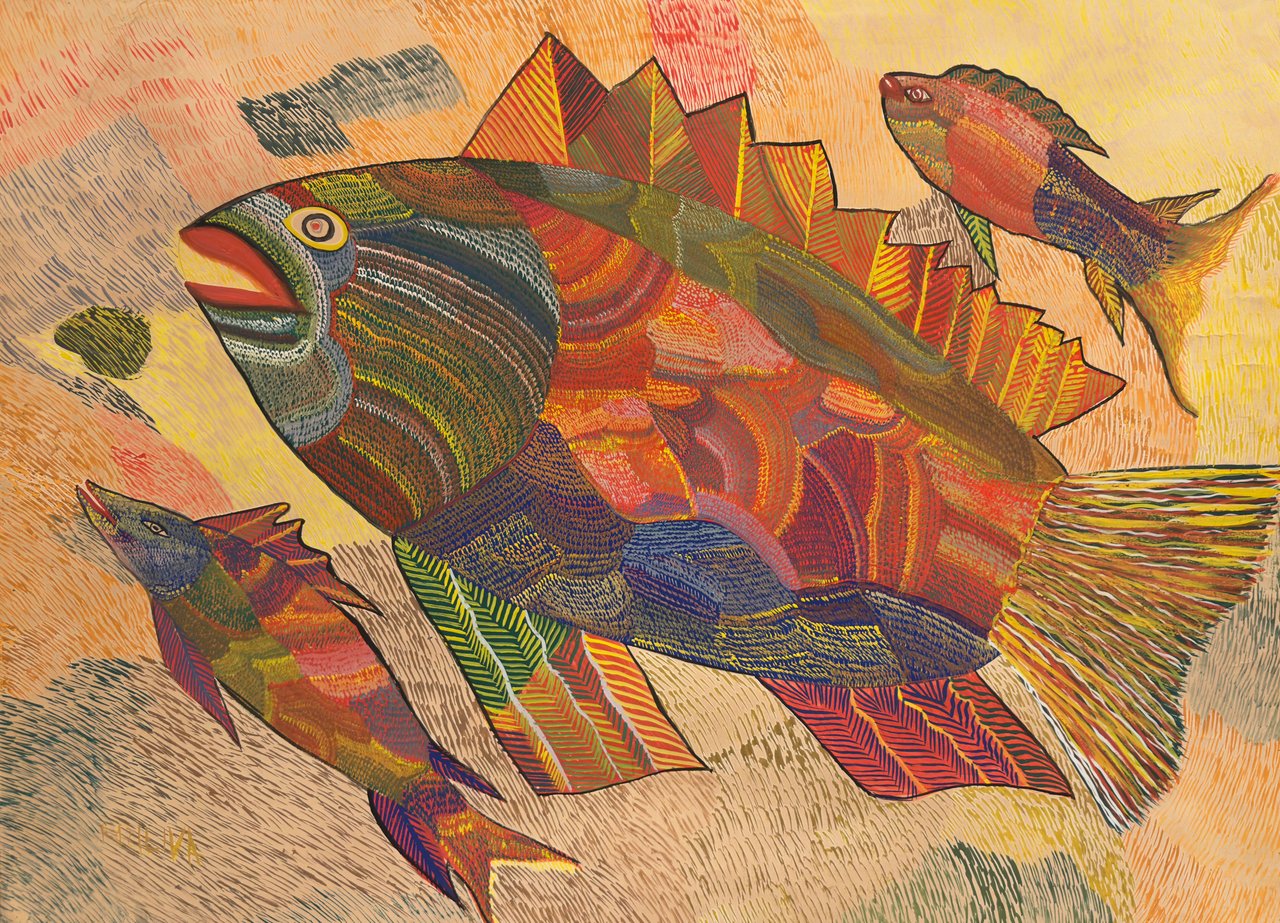
Chico da Silva’s name may lead someone to a painting of fish. Choosing that painting among others will require finding something more specific. In Fish, the largest animal almost touches both edges of the sheet. Its serrated back occupies the upper half, and smaller fish fit into the spaces left over. The composition already gives us material for a first note: what interests us is how one enormous body arranges the presence of the smaller ones.
This observation can begin a collection. It will also help if the interest develops into research or an exhibition. Along the way, two tasks feed each other: learning to explain what holds the eye, and gathering records that allow us to recognise the object and follow its history. The paintings in this article offer a way to try both.
Before searching for a similar work
In Fish, painted around 1966, the largest animal’s colours divide into fields. Blue weighs on the belly; reds and greens cross the back. Within these fields, small strokes change direction. Similar strokes reappear in the background, but the fish’s dark edge keeps the body separate. The image combines an almost continuous surface of marks with a silhouette that asserts itself from a distance.
If this relationship attracts us, it can guide the next search. Looking only for “another fish” may lead to a work with a similar subject that does something quite different with space. Looking for bodies divided into areas of colour, or figures that almost fill their support, allows us to compare solutions in painting.
A useful note keeps the reason for our interest: “The large fish creates two intervals for the smaller ones; strokes bring figure and ground together.” On returning to the image months later, this sentence restores a question we can confirm, correct or abandon. A collection begins to find a focus when these questions accumulate and start to guide encounters between works.
A category opens a search
“Naïve art” can lead to painters and catalogues we have yet to encounter. The French auction house Ader, for example, brings naïve art, art brut and Lettrism together in its Art & Utopie department.1 The arrangement helps locate works; different practices coexist within it.
Someone arriving through a category can continue with a narrower choice: an artist, a period, invented animals or works on paper. This focus becomes productive when it allows comparison. Two birds by the same painter may reveal differences in gesture, scale and the rhythm of strokes. A collection assembled simply to complete a list of names may leave little room for discovering what each painting does.
It is also useful to follow how the term has been used in exhibitions and studies. The article on Brazilian naïve art traces that history. When studying a particular object, the category remains an entrance; we need to reach its materials, measurements and records.
When two reproductions look the same size
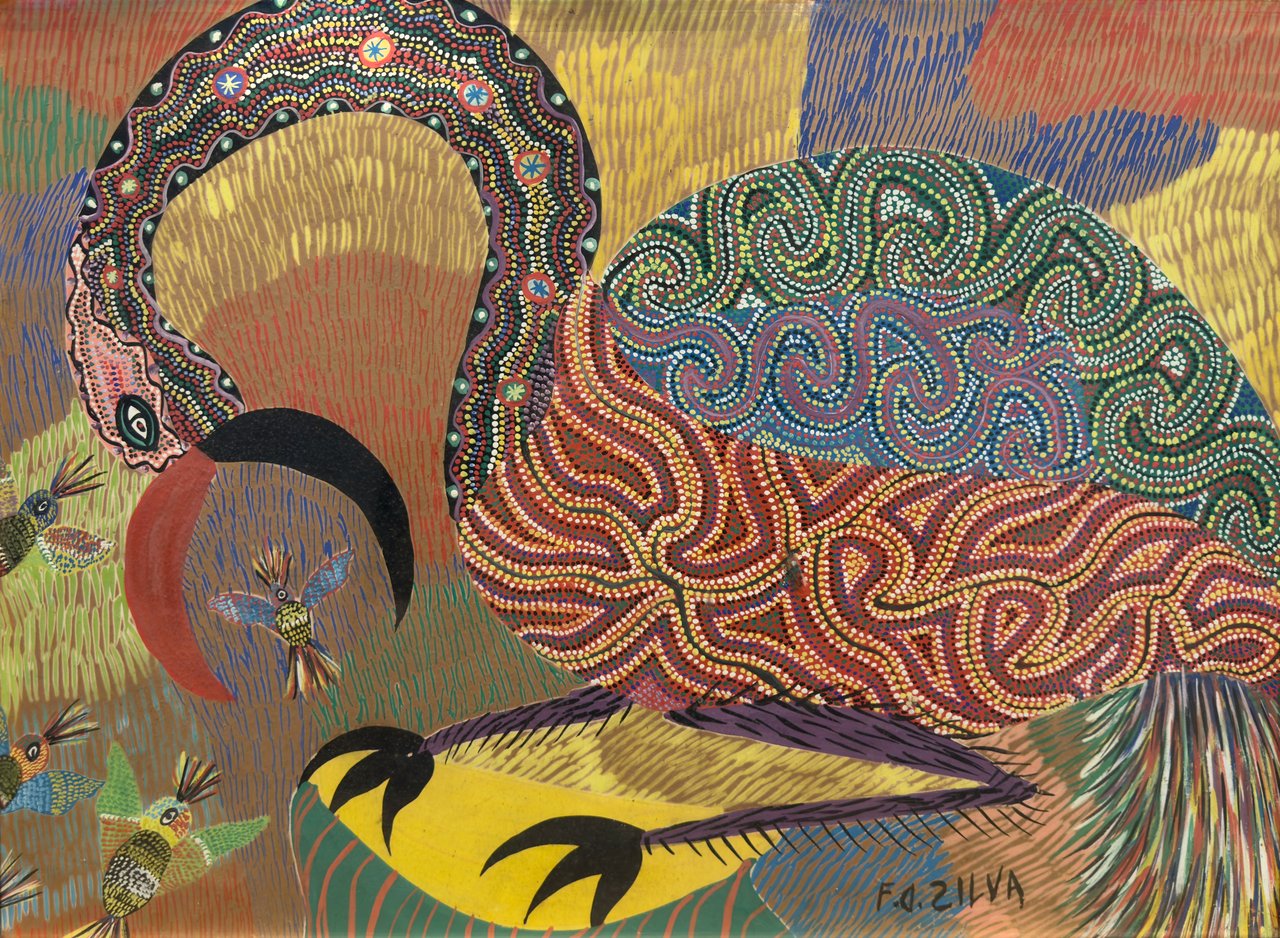
On a computer screen, Fish and Fantastic Bird and Fledglings may occupy the same width. Their records restore a physical difference: the first is a gouache on paper measuring 54 × 74 cm; the second, also gouache on paper, measures 43 × 59 cm. The bird’s sheet is about four fifths the width of the fish sheet.2 The equivalence of digital images conceals an encounter with objects of different sizes.
Size changes our expectations of looking closely. In the bird, the long neck creates an arch containing smaller birds. Paths of dots fill the body, and violet legs cross a yellow area beneath the belly. In an enlarged reproduction, we may forget that these small marks belong to a smaller sheet. A detail that fills a monitor may require physical proximity to the paper.
Read dimensions with their order and unit, and check whether they measure the work or its frame. When a description says only “painting”, ask for the medium and support in full. The Object ID documentation standard promoted by ICOM includes materials, measurements, markings, photographs and a short description among its identification information.3
The date deserves the same precision. The catalogue places Fish around 1966 and Fantastic Bird and Fledglings around 1969. These are approximate dates, distinct from a year inscribed on the painting. When copying a record, keep the approximation and the source of the information. A “circa” lost between folders turns a dating hypothesis into apparent certainty.
The object’s journey and the painter’s biography
An important exhibition in an artist’s life does not establish that a particular painting was included. To place that event in the work’s history, we need a record identifying it. This might be a reproduction in the catalogue, a list with a number and measurements, a label supported by documentation or a photograph in which the object can be recognised.
The French Ministry of Culture defines provenance research as reconstructing a work’s journey from its creation to its present location. Starting points include examining the reverse, marks and labels, catalogues and sale records.4 The purpose is to follow that object. Its title, image and dimensions therefore need to be checked against each document.
Imagine finding an old catalogue with an entry called Fish. The title alone leaves several possibilities. A reproduction may settle the identity; without an image, measurements and a description of the arrangement of animals can help test the match. A difference in title might be explained by a later caption, while differing dimensions may require checking whether a frame was included. Each explanation needs supporting evidence.
An oral account can also begin research. Record who spoke, when and how that person was connected to the painting. Then look for the document mentioned in the account. Keeping “reported by” separate from “listed in the catalogue” retains what each source actually allows us to say. A gap becomes easier to investigate when its boundaries are clear: between which owner and which exhibition is a record missing?
Finding a catalogue and being able to read it
INHA provides guidance for finding works and sale catalogues, including open databases and resources requiring library access.5 A database address starts the work. A useful reference reaches the document: auction house or institution, location, date, catalogue title, lot or page, and a corresponding image where one exists.
When saving a digital record, keep the page consulted and the access date. If there is a PDF of the complete catalogue, keep it with the reference. A screenshot without the institution’s name may become impossible to locate later. Also check whether the number beside an image is a page, lot or exhibition number: these organise a document in different ways.
Research can change a question. A title found in an inventory may lead to another spelling of the painter’s name; a label may point to a gallery previously absent from the work’s journey. These discoveries belong beside the record, with the document that lets someone revisit them. The dossier then also records how knowledge of the painting was formed.
The painting that changes a collection’s focus
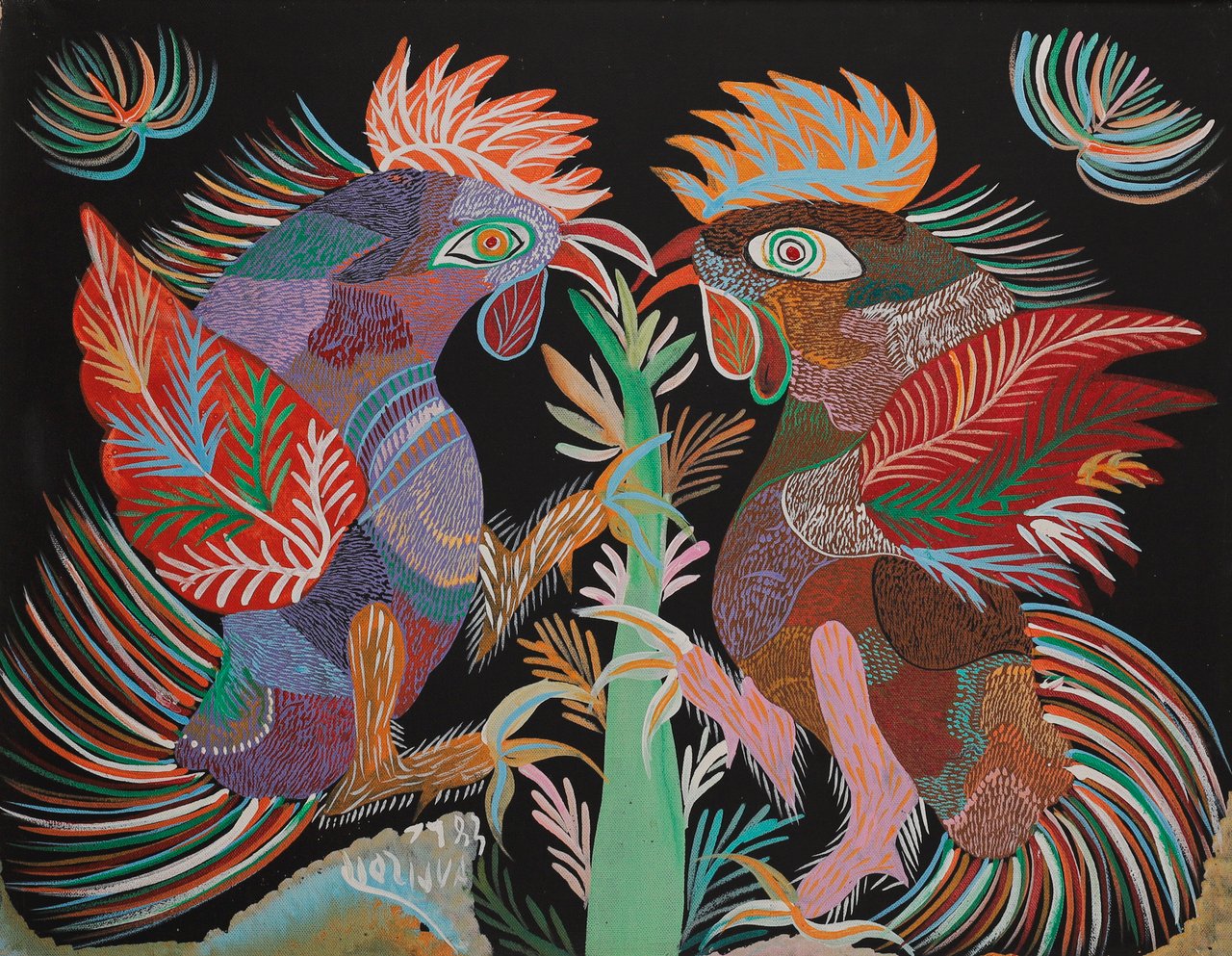
Cockfight, painted in 1983, is an acrylic on canvas measuring 50 × 70 cm.2 The black ground separates the heads and makes the red feathers’ outlines clear. A green stem grows between the cockerels; their beaks almost meet above it. Wings project to either side, and raised feet concentrate the action in the centre.
Beside the two gouaches on paper, this canvas offers another arrangement of empty space. In Fish, strokes cover almost the entire surface; in the cockerels, black intervals remain visible between the figures. For an exhibition, this may justify bringing the works together: visitors can compare two ways of separating animals and ground. For a collection devoted solely to works on paper, the same canvas would require reconsidering its focus.
It helps to formulate the choice before making novelty a rule. The question can be simple: does this painting introduce a difference the collection wants to study? The answer depends on the works already gathered and the collector’s project. Knowing the repertoire better allows us both to welcome an exception and to understand why it does not belong in that particular group.
What remains in the folder after the first interest
An object file should allow another person to resume the investigation. Keep together:
- the object’s identity, with the number linking its record, images and documents;
- photographs of the complete front and reverse, with details of inscriptions relevant to the research;
- the technical record, including sources for dates and units for measurements;
- documents of circulation, exhibition and publication, each connected to the statement it supports;
- open questions, with the record or examination needed to answer them.
Examining the material object requires another kind of proximity. A condition report describes its physical state; an ownership history records its journey. Cabinet Turquin, which specialises in Old Master paintings, brings direct examination, documentary research and consultation with specialists together in its method.6 This combination shows why photographs and documents answer different parts of an enquiry.
As interest develops, a precise question is more useful than a general request for information. We might ask for a reading of an inscription, the page of a cited catalogue or an examination of a particular area of the surface. An investigation can continue when the next person knows which painting they are looking at and what remains to be understood.
Notes
-
Ader, Art & Utopie, introduction to the department. ↩
-
João Cunha Collection records: Fish, jcc-088, Fantastic Bird and Fledglings, jcc-085 and Cockfight, jcc-030. Medium, support, dimensions and dates; visual observations made from the reproductions. ↩ ↩2
-
ICOM, Object ID, categories and steps in the object identification standard. ↩
-
French Ministry of Culture, Qu’est-ce que la recherche de provenance ?, definition and section on material and documentary research. ↩
-
Céline Cachaud, INHA, Les ressources électroniques : recherche dans le marché de l’art, guide to finding works and sale catalogues, updated 8 June 2026. ↩
-
Cabinet Turquin, Notre méthode, sections on direct examination, documentation and specialists. ↩