Chico da Silva and Brazilian Naïve Art
Where Chico da Silva stands in Brazilian naïve art: the first primitive painters, the 1966 Venice mention and the naïve painter who became a school.
Brazilian naïve art has a first generation, the painters found in the 1930s and 1940s far from the fine-art academies, and Chico da Silva is one of them. When critics placed him in the category, the sociologist Gerciane Oliveira sums up, they meant spontaneity, no ties to any pictorial tradition and no concern for the techniques that convention had laid down. Until the early 1970s these self-taught painters of working-class origin were mostly called primitives in Brazil; the word later took on a pejorative weight and gave way to naïve.
Neither word sat easily on this work. Clarival do Prado Valladares wrote in 1966 that there was nothing crude about Chico, and the curators of the 2020s swapped naïve for Indigenous. Why no label ever settled is the subject of Primitive, Naïve, Indigenous. The question here comes first: what Brazilian naïve art is, and where in it he stands. Three facts set him apart from his neighbours under the label: he painted invented creatures, not the life around him; he received an honourable mention at the Venice Biennale in 1966; and his painting turned into a collective studio, the Pirambu School, which carries on in the hands of his disciples.
The first generation
The chronology that Roberto Galvão takes from Lélia Coelho Frota in Chico da Silva e a Escola do Pirambu (1986) lines the names up. Cardosinho, a Portuguese immigrant in Rio de Janeiro, starts painting in 1931, already retired; Gerciane Oliveira treats him as the forerunner of naïve art in Brazil and says he was discovered by Portinari and by the Japanese-French painter Foujita. Heitor dos Prazeres starts in 1937. In 1943 the Swiss painter Jean-Pierre Chabloz sees Chico’s drawings on the walls of Praia Formosa, in Fortaleza, and goes looking for whoever made them. In 1946 the critic Paulo Mendes de Almeida comes across the painting of José Antônio da Silva in São José do Rio Preto. In 1947 Augusto Rodrigues tracks down Vitalino in Caruaru and, the same year, mounts the first exhibition of his clay figures in Rio. Frota notes that Cardosinho, José Antônio and Chico were earning articles and becoming known at the same time.
The story is usually told as a string of discoveries. In 1979 Sérgio Viotti’s series “Os primitivos brasileiros”, in the Suplemento Cultural of O Estado de S. Paulo, listed the cases one after another: Marcier encouraged Djanira, José Antônio had the backing of established critics, “Jean Chabloz, a Swiss, found Chico da Silva”. Gerciane Oliveira calls this the biographical formula of the chance discovery: the artist is found because of a talent nobody disputes. Not everyone accepted the word that came with it. Djanira, once she had made her name, preferred not to be classed as a primitive.
Creatures instead of scenes
What separates Chico from his neighbours is subject matter. José Antônio painted landscape and rural life. Heitor dos Prazeres painted the religious life and popular culture of Rio, and the 2023 exhibition “Heitor dos Prazeres é meu nome”, at the Centro Cultural Banco do Brasil in Rio, reread that work through his experience as a Black man living in the city’s suburbs. Chico did not paint the life around him. He painted dragons, flying fish, birds and snakes in flat colour, with no depth and no empty space, a repertoire that changed little in forty years.
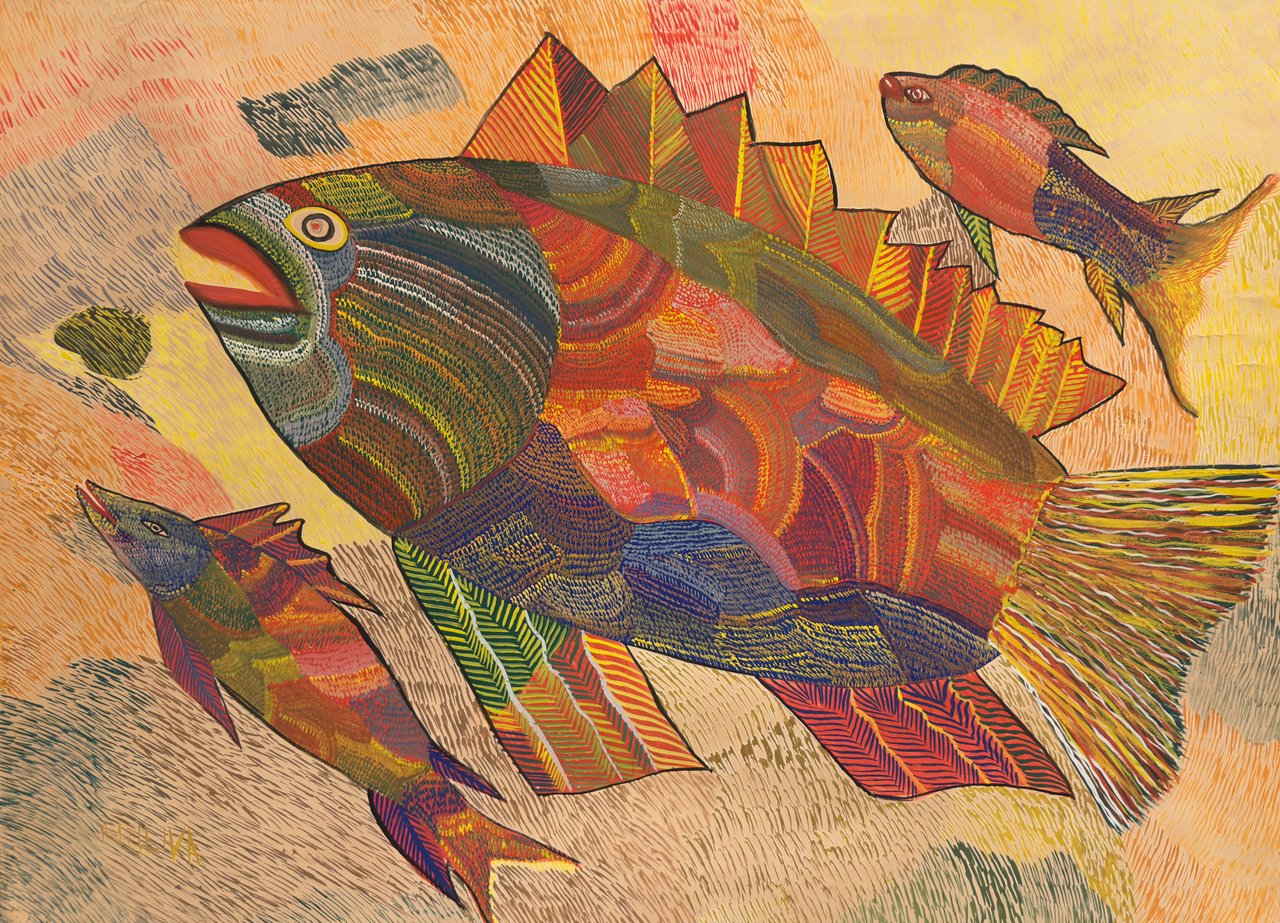
Oscar D’Ambrosio, quoted by Gerciane Oliveira, proposes a working split within the genre: primitive for the artist of rural subjects, naïve for the urban one. Neither countryside nor city appears in Chico’s pictures. Fish, a gouache on paper from around 1966, shows three fish on a ground of short strokes in ochre, cream and grey blue. The largest crosses the sheet from end to end, its mouth open on a deep red, its back bristling with spines that rise like leaves.
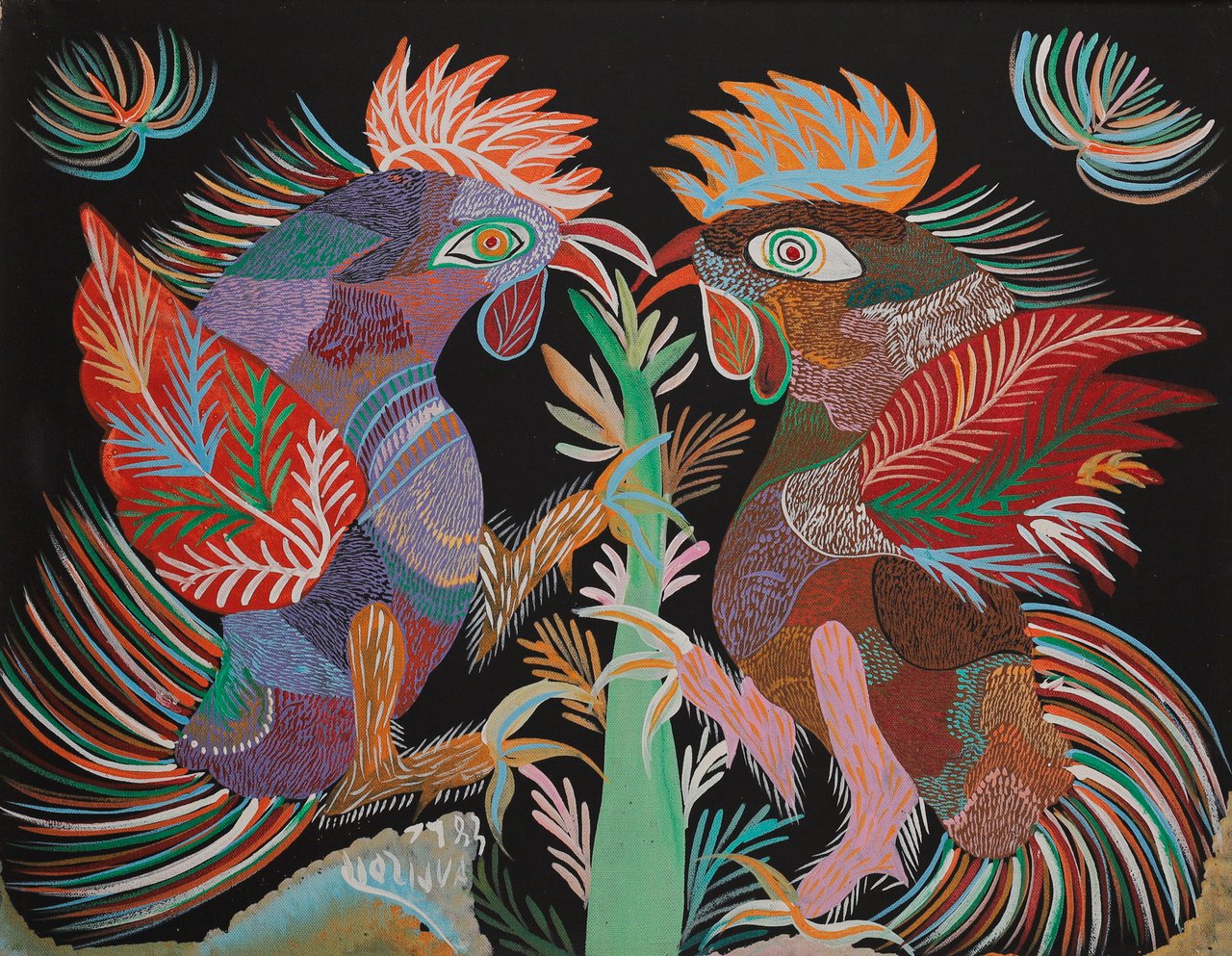
Even when the motif came from the street, the street stayed out. In Cockfight, acrylic on canvas from 1983, there is no pit and no crowd: two roosters face each other on black, parted by a thin green stalk, and the rest of the canvas is plumes and fronds opening out in red, orange and green.
Venice and the genre’s circuit
International standing came in 1966. Valladares chose twelve gouaches from the university museum in Ceará for the Brazilian delegation to the 33rd Venice Biennale, and the jury gave Chico an honourable mention that the critic himself described as unprecedented, in the history of the show, for a primitive. How it came about, and what the press made of it afterwards, is in Venice, 1966.
The genre had its own circuit abroad, and the work entered it. In 1979 Viotti recorded that Brazilian primitives had reached the museum in Laval, in France, the birthplace of Henri Rousseau, the Douanier. The museum of naïve art in Laval still holds Animaux fantastiques, a 1966 gouache by Chico.
The naïve painter who became a school
In the discovery formula, the naïve painter is a single hand, and Chico’s stopped being single early on. Between late 1963 and early 1964, Galvão writes, demand outran what he could deliver, and Chico began working with boys from the neighbourhood, in Pirambu, Fortaleza. The core had five names: Babá, Claudionor, Garcia, Ivan de Assis and Chica, the painter’s daughter. The work was split by stage: some drew the outlines, others filled in the colours and did the stippling, and the master kept the finishing, the varnish, the signature and the sale for himself. The studio is the Pirambu School; what spread out from it, with parallel workshops and forgeries, is in The Painting Factory.
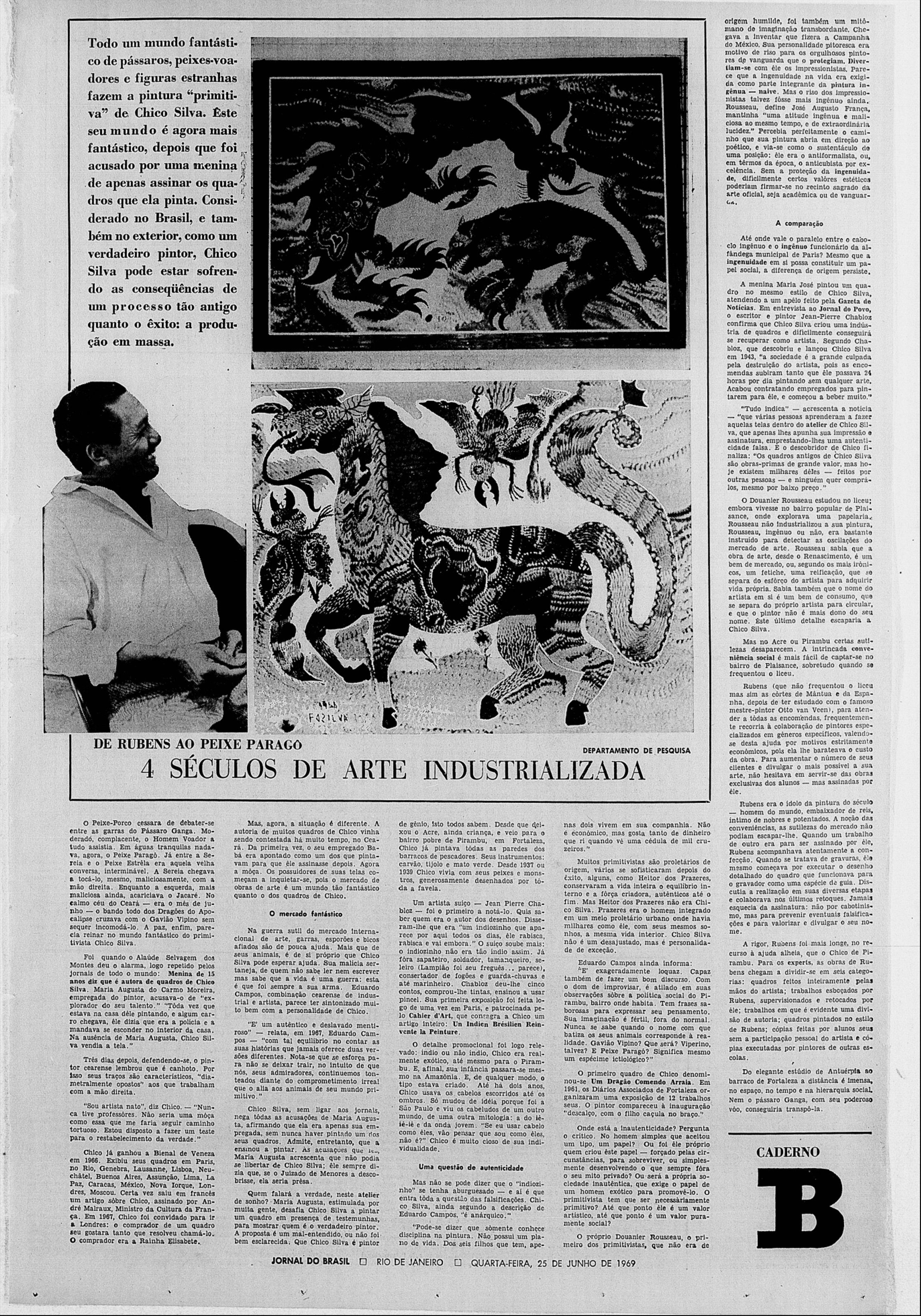
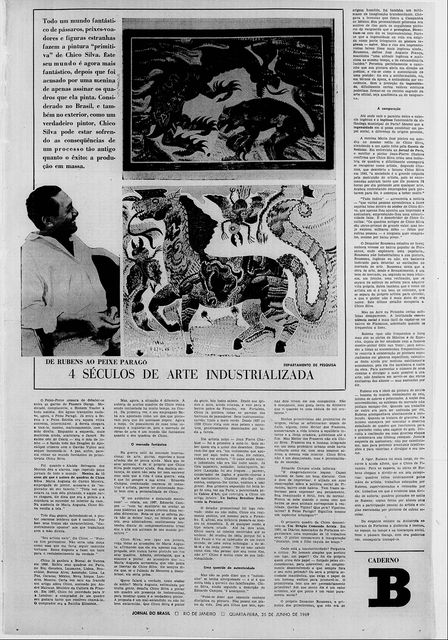
When the arrangement became public in 1969, the press looked for a comparison inside the genre and landed on Heitor dos Prazeres. In June the Jornal do Brasil set the two side by side to tell them apart: Prazeres was a man rooted in an urban working-class milieu where there were thousands like him, and Chico was “a personality of exception”. In July, in O Globo, the critic José Roberto Teixeira Leite recalled that Heitor, “another primitive”, also had assistants.
High-resolution viewer. Use the arrow keys to pan, plus and minus to zoom.
The comparison with his peers came back in the market, and there the workshop counted against him. In the 1983 public sale records that Gerciane Oliveira gathered, a gouache by José Antônio da Silva sold for Cr$ 50,000 and one by Chico for Cr$ 15,000; she counts the constant suspicion over authorship among the reasons for the gap.
In Pirambu, the assistants became disciples with names. In March 1977 the five showed as “Os Pintores do Pirambu” and began signing with their own names; in April they painted, with the master and in front of the public, the four-by-two-metre panel Homens Trabalhando. Chico left hospital every day to work on the canvas and signed it at the end.
The manner in the disciples’ hands
The way of painting outlived the master. Galvão writes that the painting of Babá, the first disciple, became the standard the whole school chased, to the point that some thought it better than Chico’s own. The group scattered while the master was still alive and came back after his death in 1985: Garcia, who had gone to São Paulo in 1973, took up painting again around 2000, and Babá returned to canvas in 2004. Gerardo da Silva, the painter’s grandson, took first place at the 2004 Bienal Naïf, according to Gerciane Oliveira’s thesis; it is the show she herself describes as the most important of the genre in Brazil.
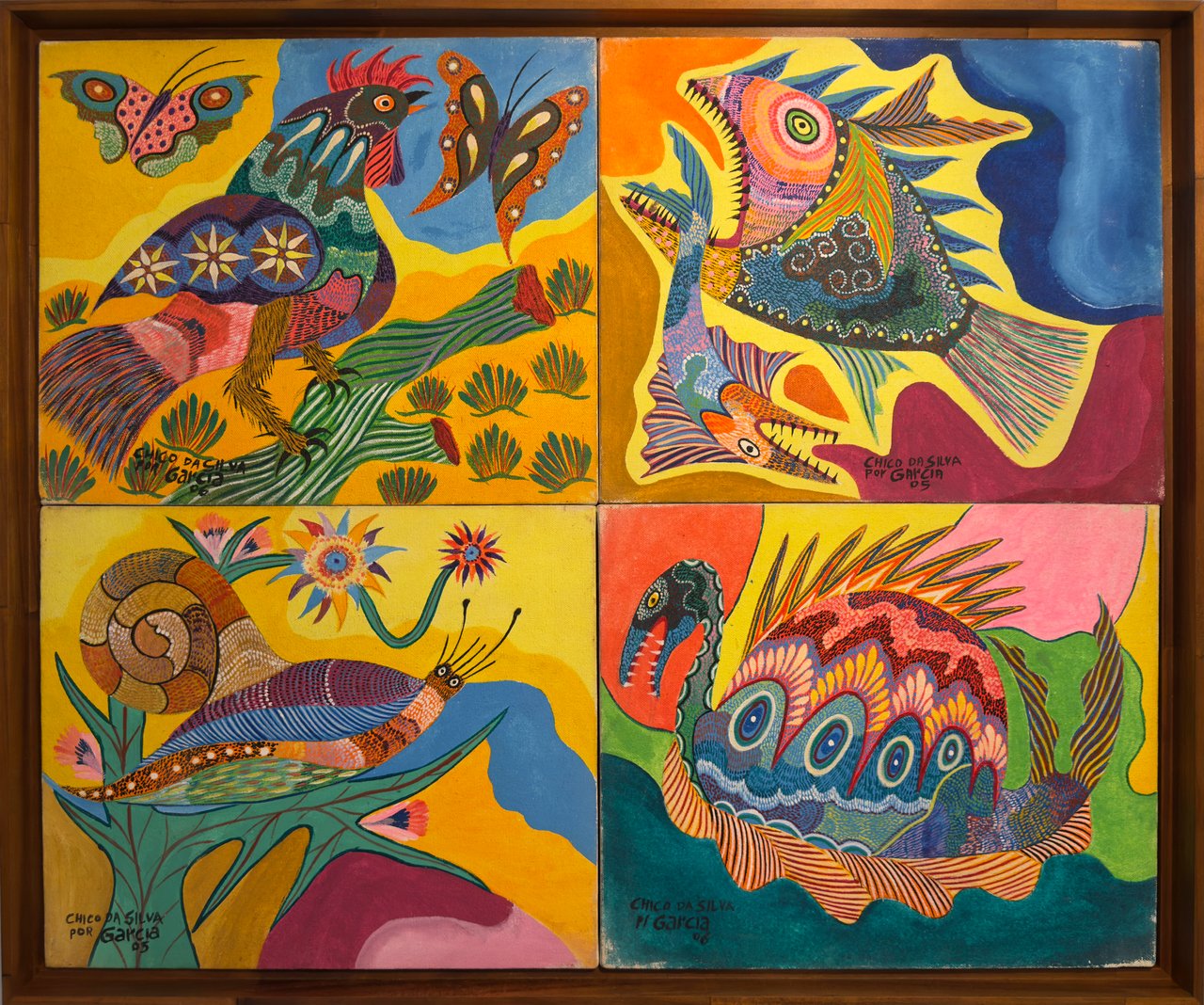
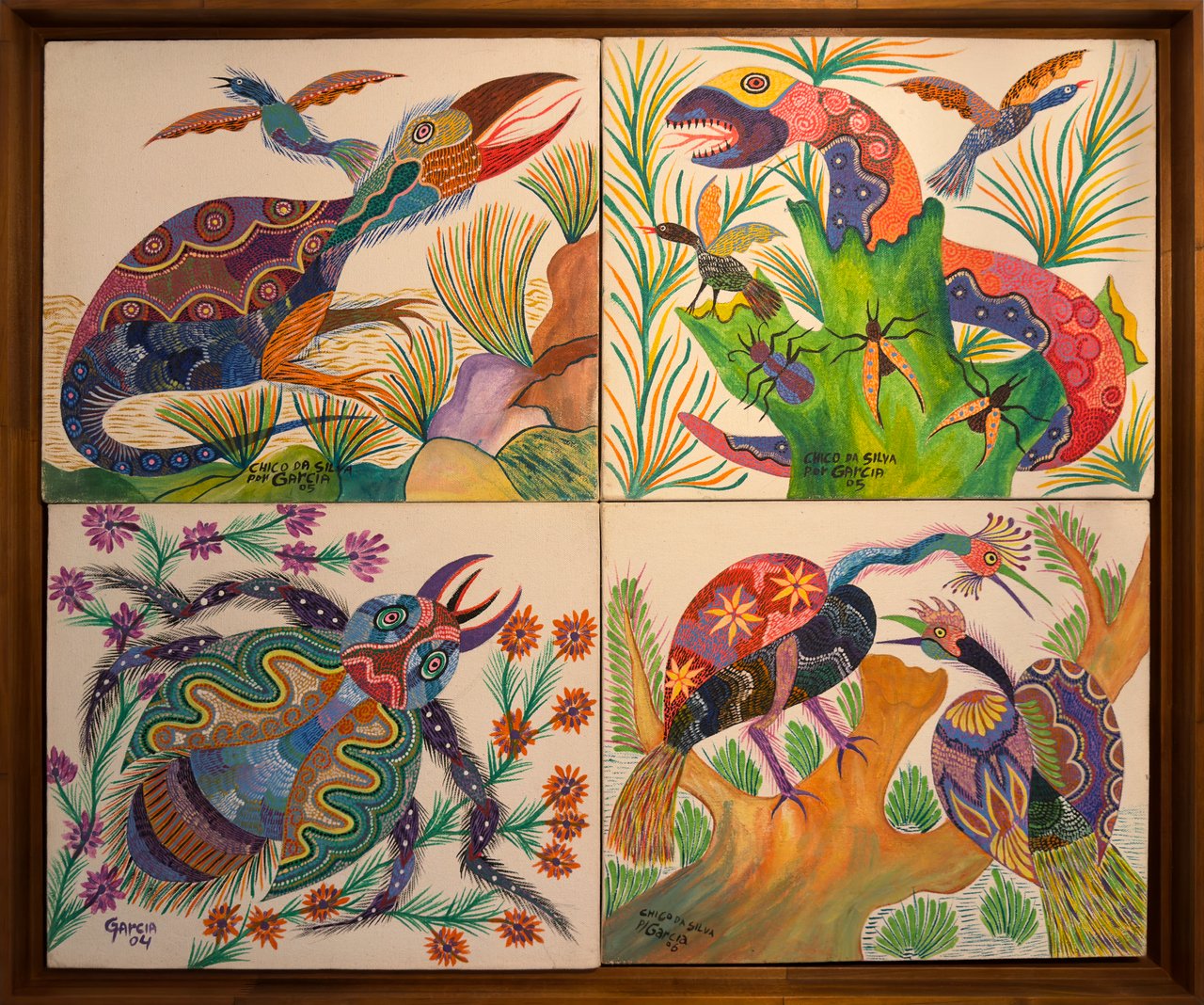
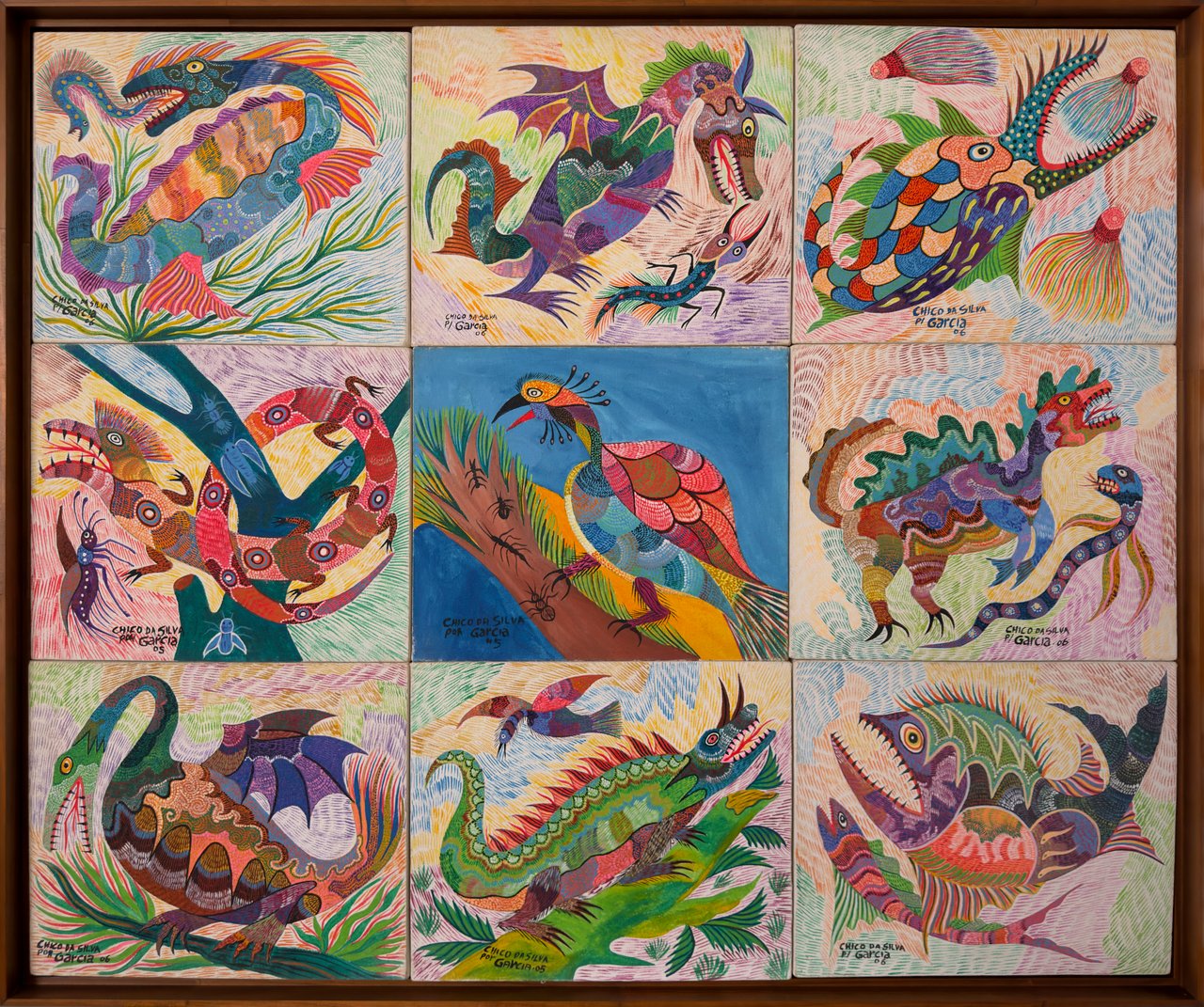
The polyptychs take the master’s grammar apart into pieces. In Fantastic Animals, from 2006, Garcia set nine small canvases in a single wooden box frame, in three rows of three, each with one or two creatures: a sea serpent with jaws full of teeth, a dragon with purple bat wings, fantastic fish, a crested bird. Each panel makes a whole picture out of the repertoire Garcia learned as a boy, in the backyard next to Chico’s.
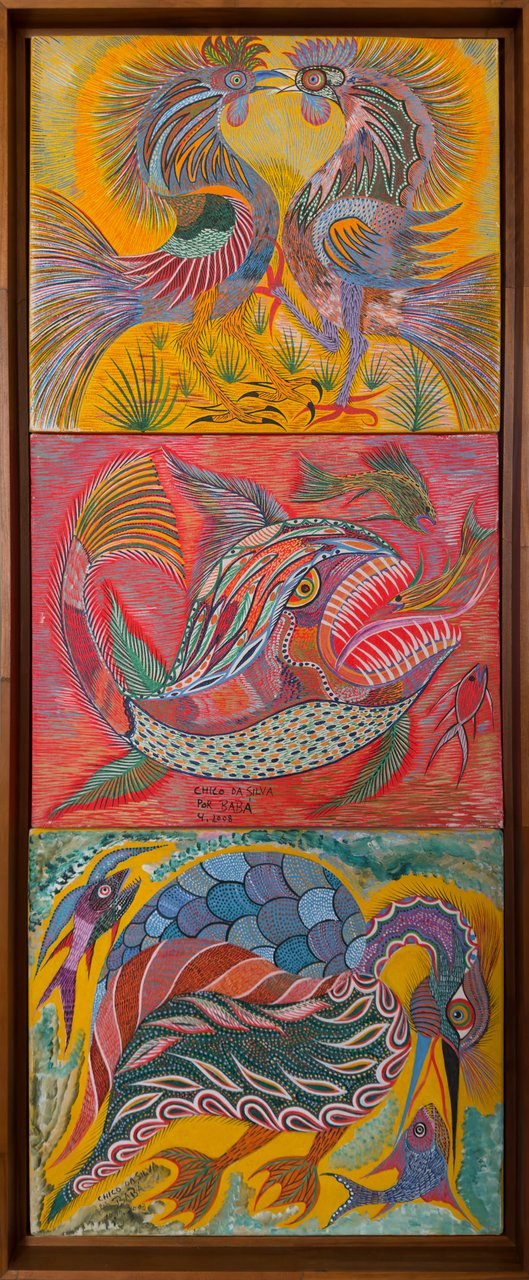
Babá did the same vertically in 2008: three canvases stacked in a tall box, two roosters beak to beak on yellow, a fish with gaping jaws on red and, at the bottom, a heron reaching its beak down to a fish. In the João Cunha Collection these canvases carry a double attribution, Chico da Silva by Garcia and Chico da Silva by Babá: the world is Chico’s, the handling is the disciple’s. Garcia, the last living member of the core, still paints in Fortaleza, and the collection’s paintings show both hands side by side.