Babá, the First Disciple
Babá (Sebastião Lima da Silva), the first disciple of Chico da Silva in Pirambu: Bluhm's workshop, the 1966 scandal and a signature of his own from 1977.
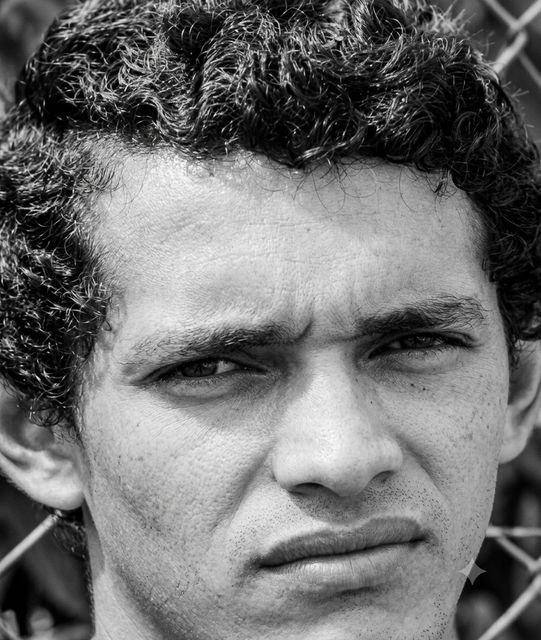
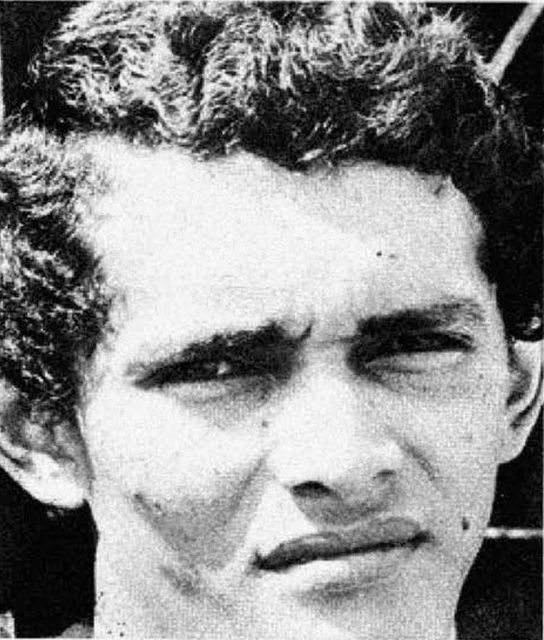
Sebastião Lima da Silva signs his paintings Babá. He was the first of the Pirambu boys to put his hand to a painting by Chico da Silva, and his way of painting became the standard for the whole group. Those who studied the school at close range interviewed him: the political scientist David Silberstein, who published his study of the trade in 1977 in the Revista de Ciências Sociais of the Federal University of Ceará and calls him Chico’s first disciple; and Roberto Galvão, author of Chico da Silva e a Escola do Pirambu (1986). The volume A Escola do Pirambu: um legado de Chico da Silva, edited by the curator Flávia Muluc in 2024, gathers both texts and is the main source for this article. The João Cunha Collection holds 27 canvases he painted between 2004 and 2011.
The shoe shop and the window
His father had a shoemaking shop and wanted the boy to learn the trade. Babá met Chico in a commotion, Galvão writes: the press went to visit the painter at the house on Rua Santa Inês and the boy went to see. After that he spent nearly all his time watching Chico paint. Galvão dates the first helpers to late 1963 or early 1964 and describes the course of the apprenticeship, the same one Garcia would follow later: first the filling, flat colour inside the drawn line; then the pigmentation, the stippling that gave the texture; and only some time afterwards the invention of figures.
Who came first, Galvão leaves open. Babá was the first to paint with Chico, he writes, but Claudionor may have started earlier on the drawings, and Ivan, in his account to Galvão, thought the pads of already drawn paper he saw at Chico’s house were Claudionor’s. Claudionor himself, in the memoir his family published in 2024, disagrees on one point: he says Babá could not draw, and that when the orders piled up he cut up Claudionor’s drawings to use as templates and copy them onto canvas.

Bluhm’s house
Henrique Bluhm, Chico’s first dealer, turned up in Pirambu unannounced and found the painter drunk and the helpers at work on the pictures. That is how he learned other hands were involved. He tried to move Chico out of the neighbourhood to paint and failed, because the painter had customers buying at his own door. The solution was to send Babá. Chico would leave him there and come by at the end of the day only to sign the paintings. According to Galvão, who credits the account to Babá himself, this is where the first workshop parallel to Chico’s studio begins. Bluhm’s wife, Di Caura, painted too, and whose drawings that workshop used is not known. Silberstein describes the same arrangement and places the work at the back of the snack bar Bluhm ran in central Fortaleza. Claudionor, who sold the dealer drawings on duplex paper, gives the name of the place, Lanchonete D’Caura, and says the ones painting those drawings were Chico and Babá. The chronology in Chico da Silva: do delírio ao dilúvio, which Galvão published in 1989, marks 1965 as the year Bluhm hired Babá.
February 1966
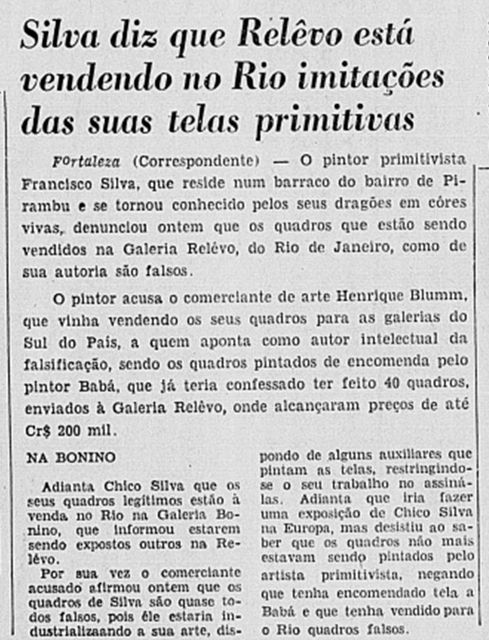
The arrangement broke open in February 1966. On 8 February the Jornal do Brasil reported from Fortaleza that Chico had denounced as fakes the paintings the Galeria Relevo was selling in Rio de Janeiro under his name. The painter named Bluhm as the mastermind and said the canvases had been painted to order by Babá, who “already confessed to having made 40 paintings”, at prices up to Cr$ 200,000. In the same report Bluhm replied that almost all of Chico’s paintings were fakes, because he was industrialising his art and doing no more than signing it, and denied ordering any canvas from Babá. Estrigas records that the complaint to the police came from Dalva, the painter’s wife. Galvão notes the detail that undoes the accusation: at the police station, Chico authenticated works that were Babá’s.
High-resolution viewer. Use the arrow keys to pan, plus and minus to zoom.
The scandal ended both the workshop and his place in the master’s house. Babá never went back to work in Chico’s studio. He tried a solo exhibition with government support at the Casa de Cultura Raimundo Cela, without success, Galvão writes, and set up a workshop of his own in Pirambu, where, like the master, he turned to helpers and enlarged the number of people making Chicos da Silva. Two of his brothers, Manuel and Carlos, known as Cainha, are on the list of painters Galvão compiled. Claudionor tells the same thing from the inside: even Babá’s brothers tried their luck at primitivism, and the decade paid well.

The hand that became the standard
The strongest judgement Galvão makes in the monograph is about Babá’s handling of paint. Although Chico meant to be the catalyst of that painting, he writes, the way almost everyone in the Escola do Pirambu painted was markedly shaped by Babá’s painting, and not out of any deliberate wish to imitate him: “his painting was simply the most beautiful”, to the point that some rated it above the master’s, and it became the standard to reach. Galvão credits him with bringing mandala forms into the repertoire, as he credits Chica with the rosettes and the black grounds. Garcia, in the documentary Memória e Imaginário (2024), describes him as the painstaking one in the workshop, the one who liked fine finishing. In the 2024 volume the researcher Lucas Dilacerda writes the school as though it had a teaching staff, and Babá’s subject is the difficult vocabulary of shapes and colours.

His own name on the canvas
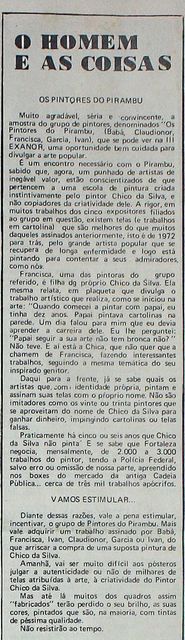
In 1977 the artist Hélio Rôla, the restorer Gilberto Brito and Silberstein founded in Fortaleza the study group “Chico da Silva e a Escola do Pirambu”, to show the craft of the five against the version the press kept repeating; the group’s history is in the article on the Pirambu school. In March they exhibited as “Os Pintores do Pirambu” at the third EXANOR, and it was from that show onwards, Silberstein records, that they began signing paintings with their own names. The column “O Homem e as Coisas”, in the Correio do Ceará of 16 March 1977, wrote that it was worth more to buy a work signed by Babá, Francisca, Ivan, Claudionor or Garcia than to risk buying a supposed Chico da Silva. The following month, at the 27th Salão de Abril, the five painted before the public, at the Casa de Cultura Raimundo Cela, over seven days, the panel Homens Trabalhando, four metres by two, acrylic on canvas; Chico left hospital to work alongside them and signed the piece at the end, and Marcus Vale and João Vale filmed it all on Super-8. The canvas entered the collection of the Art Museum of the Federal University of Ceará in 2023, after the process the 2024 volume reconstructs. Of what Babá signed in those years, the book reproduces two untitled canvases, from 1973 and 1979, in Hélio Rôla’s collection.
High-resolution viewer. Use the arrow keys to pan, plus and minus to zoom.
2004: back to the canvas
Erika Cavalcanti, a journalist and Claudionor’s daughter, writes in the preface to her father’s memoir that the partnership with the Instituto Cultural Oboé grew out of his reunion with Garcia and Babá in mid-2004. That cycle has an article of its own, the Instituto Oboé. Chico had been dead for nearly twenty years, each painter signed his own name, and the material was acrylic on canvas, in formats around 75 by 100 centimetres. The 27 paintings by Babá in the João Cunha Collection come from that period, 2004 to 2011, and enter the catalogue under the double attribution Chico da Silva by Babá: the world is the founder’s, the handling is the disciple’s.

The sociologist Gerciane Oliveira interviewed him in 2014 for the thesis É ou não é um quadro Chico da Silva?, defended at the Federal University of Ceará the following year. In April and May 2024 works by all five were shown at the Centro Cultural Belchior, in Praia de Iracema, Fortaleza, with canvases from Hélio Rôla’s collection, and the book came out of that show. It names Garcia as the only member of the core still alive. Babá’s canvases are in the index of paintings, beside the works Chico signed himself.


