Claudionor, the Draughtsman
José Claudionor Nogueira (1945–2010), who drew the creatures of Chico da Silva's Pirambu School: the Mercantil São José panels and the 2010 memoir.
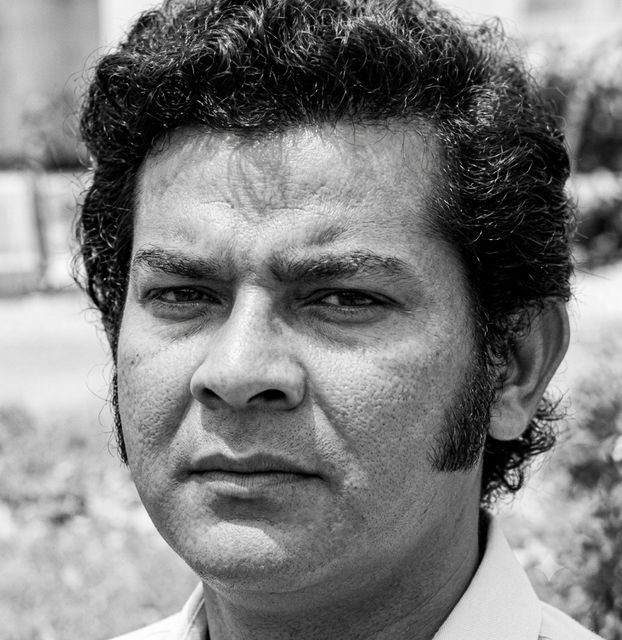
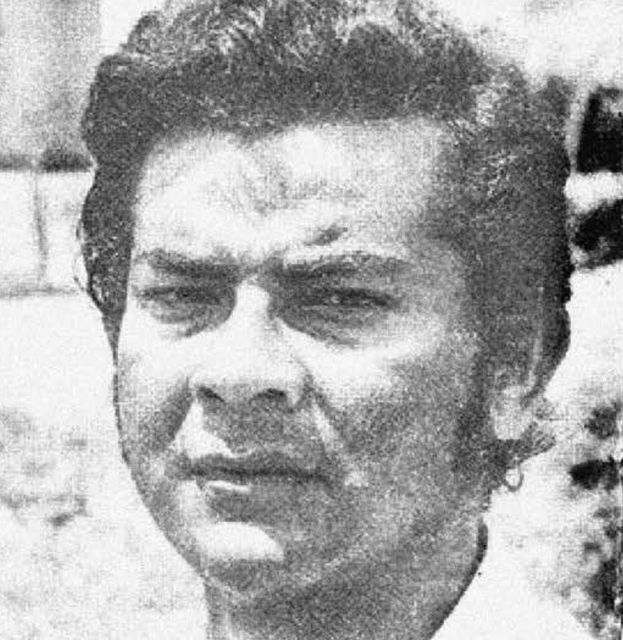
José Claudionor Nogueira signed his paintings Claudionor. In the group around Chico da Silva in Pirambu he was the draughtsman: the hand that drew the creature on card for the others to fill with colour. The name in full comes from the volume A Escola do Pirambu: um legado de Chico da Silva, which the curator Flávia Muluc organised in 2024 and which prints his memoir; the list Roberto Galvão compiled of everyone who painted Chicos da Silva gives José Cláudio Nogueira, and the two spellings have run side by side ever since. He was born in Maranguape, in the hills west of Fortaleza, on 2 November 1945, and died in Fortaleza on 18 October 2010. Much of what follows is in his own voice, from the memoir he dictated in 2010 under the title Chico gave him, “O Monstruoso Leão Pantera”, presented by his daughter Erika Cavalcanti and published for the first time in that 2024 volume. The João Cunha Collection holds six canvases he painted in the 2000s.
A sidewalk of burnt cement
The family came down from Maranguape to Pirambu when he was small, and the neighbourhood he describes is half fishing village, half backland: houses of wattle and palm thatch, streets laid out badly, dunes running to the sea. His father sold charcoal on a donkey to the rich houses of Jacarecanga; his mother took in washing. Because the sand blew indoors as far as the kitchen, his father built the only high sidewalk on the street, in burnt cement the colour of graphite, and the boy read it as an invitation to draw.
Notebooks came first, until a teacher’s paddle put him off them; on cement he could rub the charcoal out and start again. What he drew were the heroes of the Sunday matinee at the Cine Majestick, Tarzan and Durango Kid and the rest, and the neighbourhood children came at the end of the afternoon to watch, before dark, because Pirambu had no electricity. He was known as Chulezinho then.
A man in a straw hat with bundles under his arm took to stopping in front of the sidewalk. He came back, looked, said the drawings were good and walked off up Rua Marcílio Dias. One afternoon he brought sheets of card and asked the boy for a mermaid and for the Senhor dos Pássaros, the lord of the birds, a figure the boy had never heard of and which the man acted out for him with faces and gestures, imitating animals in a fight. He took the drawing away and came back with more card, some comics and money for the cinema. It was Chico da Silva, whom his mother called Chico Pintor. Erika Cavalcanti dates the meeting to his eighth year, which puts these first sheets around 1953, a decade before Galvão dates the arrival of the first helpers at Chico’s house, in late 1963 or early 1964. The memoir does not reconcile the two, and what it describes is not a workshop: a boy on a sidewalk, drawing to order for a man who paid in comics.
The lord of the birds stayed with him. One canvas in this collection, undated and unsigned, puts a bearded man in pale robes among a flock of birds, one arm out towards a green dragon that coils in from the right.

Who drew the line
The division of labour is the steadiest fact in the record. David Silberstein, the political scientist who interviewed him for the study of the trade he published in 1977 in the Revista de Ciências Sociais of the Federal University of Ceará, sets it out: Claudionor, Ivan and rarely Chico himself made the drawings; Babá, Ivan and Garcia took the colour and the stippling; Chico kept the finish for himself, the coat of varnish from a flit pump, the signature and the sale. Galvão’s monograph Chico da Silva e a Escola do Pirambu (1986) says the same and adds that by the time the restorer Gilberto Brito was in and out of the house, Claudionor turned up only now and then but was still the one responsible for the drawings. The sociologist Gerciane Oliveira, who interviewed the survivors of the group, calls him its official riscador, the one who set the line. How the workshop itself came together is the subject of the article on the Pirambu school.
Who came first is not settled. Babá was the first to paint with Chico, Galvão writes, but Claudionor may have started earlier on the drawings, and Ivan told him that the pads of already drawn paper he found at Chico’s house looked like Claudionor’s line. Claudionor puts it more bluntly: Babá could not draw, and when the orders piled up he cut Claudionor’s drawings out and used them as templates.
His own market is the part no other source has. He sold sheets of duplex paper to Henrique Bluhm, Chico’s first dealer, cut in two and covered with animals, and says the ones who painted them at the Lanchonete D’Caura were Chico and Babá. He sold paintings to the dealer Pompeu Braga for Chico to sign, which he says was standard practice among the dealers. Galvão records a third workshop in which Valentin Mickaliuck bought cards from Chico that were drawn, probably, by Claudionor, and hired an advertising painter to colour them. He drew for Gilberto Brito, for Maurício Xerez, for whoever asked, on paper and canvas of every size.

Part of the bestiary came in through his hand. Galvão credits him with a repertoire of fixed types, each with a defined drawing and a name of its own, and reports that he took the alligator off the tin of Querosene Jacaré, a brand of lamp oil, and made dragons out of its shapes. The fighting cocks are disputed: Galvão gives Ivan the first one, copied from the cover of a school exercise book, while Garcia, interviewed by the Fortaleza channel TVDD in 2026, says the fight was Claudionor’s development, and that the movement in the animals came from him, because Chico’s own line was stiff. In the 2024 volume the curator Lucas Dilacerda writes the school as though it had a teaching staff, and Claudionor’s subject is drawing: lines that map unknown worlds, the ones where the dragons live.
Twelve panels and a white Beetle
The 1970s were the fat years. Demand went out of control, he writes, there were paintings at hotel doors and at the airport, he drew every kind of animal without stopping, and canvas began to replace duplex. Then came a commission of a different order. The directors of the Mercantil São José chain were building the largest supermarket in the Northeast and wanted the greatest primitivist in Brazil for the opening; they offered Chico a car, and Chico closed the deal on the spot. When it became clear the date would not wait, he took Claudionor with him. Twelve panels in blockboard, 1.22 by 2.75 metres each, for the aisles of imported goods. Chico posed for the photographs, went up, told him what to draw, laid in a few strokes, drank whisky with the directors and disappeared until the next day. Claudionor drew and his wife Fátima filled the figures, the two of them working through the nights, she on coffee. At the opening Chico got his car, a white Volkswagen Beetle, and Claudionor painted a rooster on the bonnet and lettered the doors: Homenagem do Mercantil São José.
The businessman Heribaldo Ximenes brought more of that work, including another store of the chain on Avenida Aguanambi. He went twice to Brasília. On the second trip, with Agostinho Ramires, the man who called himself Chico’s nephew, they mounted a show at a car dealership, the Valença Veículos, and sold everything they had brought. The invitation to the capital had come unofficially from Lucy Geisel, the president’s wife, and when Chico gave that as the reason for the trip to a reporter from the Correio Braziliense, the order came down to kill the story. Claudionor took the call at dinner: the head of intelligence, a Colonel Dimas, asking who was responsible and threatening to shut the paper. Galvão dates that solo show to August 1977, the month Chico left the psychiatric clinic, and notes that many of the works in it had Claudionor’s style, above all a new version of the Jesus dos Pássaros.
1977: his name on the canvas
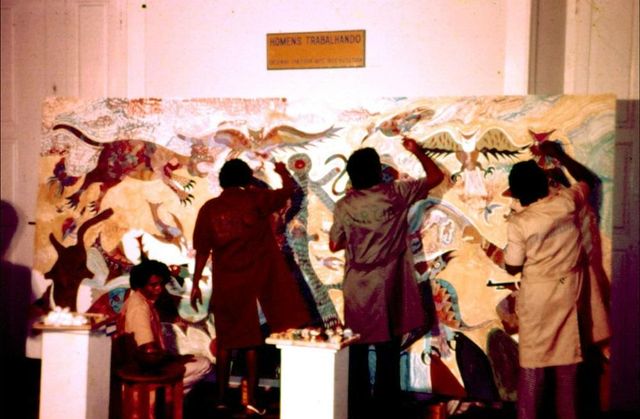
The answer to the forgery story took shape the same year, through the study group founded in Fortaleza by the artist Hélio Rôla, Gilberto Brito and Silberstein. In March the five painters of the core exhibited as “Os Pintores do Pirambu” at the third EXANOR, and from that show on they signed their own names. The column “O Homem e as Coisas”, in the Correio do Ceará of 16 March 1977, told readers it was worth more to buy a work signed by Babá, Francisca, Ivan, Claudionor or Garcia than to risk a supposed Chico da Silva. The next month, at the 27th Salão de Abril, the five painted before the public at the Casa de Cultura Raimundo Cela, over seven days, the panel Homens Trabalhando, four metres by two, in smocks with their names written across the back; Rôla, as a doctor, got permission to bring Chico out of hospital daily to work with them, and Chico signed the panel at the end. Marcus Vale and João Vale filmed it on Super-8. Chapter 13 of the memoir is given to that week, and Claudionor treats the film as evidence: in it Chico draws and paints, alongside him and the others, and the whole thing was carried out under the master’s instruction. That July the group took the case to the congress of the Sociedade Brasileira para o Progresso da Ciência, and the theme was debated at the Pinacoteca do Estado de São Paulo in an activity organised by Aracy Amaral, then the museum’s director.
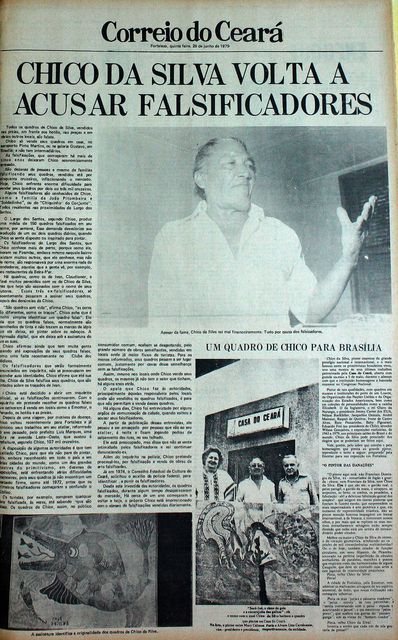
Recognition did not follow. Two years later the Correio do Ceará ran Chico accusing forgers again, and in the middle of it the paper called Ivan, Claudionor and Vavá three former forgers who had only recently begun signing their own paintings. Claudionor’s answer, written thirty years later, is that society kept ignoring them for fear of having to face what it had already bought, and that the question in the air was whether the picture on the wall was a Chico or a Claudionor, a Babá, a Garcia, an Ivan. His position on the work itself never moved: there was no forgery, because Chico did the finishing and the fur of the animals, oriented the work and took part in it.
High-resolution viewer. Use the arrow keys to pan, plus and minus to zoom.
The years he did not paint
The fight over authenticity wore him down, his daughter writes, and years afterwards he decided to stop painting canvases altogether. He hated being asked why he had not gone back to it. What he did instead was decoration, and a great deal of it: the Náutico Atlético Clube in Fortaleza from 1990, seventeen years of Bailes da Saudade; ten years of the Maranguape Clube; the Clube Português; carnival and June festivals in Maracanaú, where he was later honoured for artistic merit, in Pindoretama, and in Campina Grande, where he decorated what he calls the largest São João in the world.
Erika Cavalcanti found the address of the Associação dos Pintores do Pirambu in an old diary and talked him into going. He came home and told her the place had nearly had a fit, because nobody there knew where he was and they thought he had died. In the middle of 2004 he got back in touch with Garcia and Babá, and out of that reunion came the commission that has an article of its own, the Instituto Oboé. Chapter 16 of the memoir gives the episode its name: the rebirth of the Pirambu school.
Six canvases
The six paintings by Claudionor in the João Cunha Collection belong to that late cycle, acrylic on canvas, five of them dated 2007 and 2008, in formats around 70 by 100 centimetres. They enter the catalogue under the double attribution Chico da Silva by Claudionor: the world is the founder’s, the drawing and the handling are his. What they show is the bestiary he spent his childhood learning. A fish the length of the canvas opens a mouth full of teeth, with pink hearts floating inside its scaled body and smaller fish and birds circling it.

Two birds face each other on another canvas, one of them fanning a tail of plumes tipped with red and blue eyes, both standing in a strip of grass at the foot of a flat yellow ground.

He began writing at the start of 2010, first in a small notebook and then at the computer, his daughter typing because his eyes were going. He was in a hurry to finish, she writes, and she only understood why later; he died on 18 October that year. The text reached print in 2024, in the volume that came out of the show at the Centro Cultural Belchior, which also reproduces two untitled canvases of his, from 1973 and 1979, in Hélio Rôla’s collection. The last thing he asks for in it is recognition for his own work and for the friends who lived through it with him. His canvases are in the index of paintings, beside the ones Chico signed.

