Legacy and Rediscovery
How Chico da Silva returned to view after 1985: retrospectives in São Paulo and Fortaleza, the Escola do Pirambu debate, and a new market.
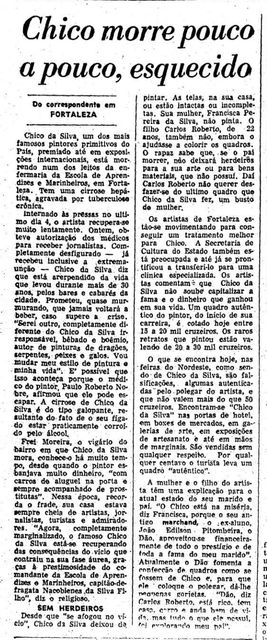
Chico da Silva died in Fortaleza on 6 December 1985. The obituary O Estado de S. Paulo printed the next day recorded the burial at the Parque da Paz cemetery, noted that his former dealers stayed away, and named the wish he did not live to see granted: the arrest of the people forging his paintings. Two decades earlier he had received an honourable mention at the 33rd Venice Biennale of 1966, a distinction the same newspaper’s 1980 profile of the painter had recorded. The space between those two scenes is the subject here: a long stretch of relative silence, then a rediscovery that gathered speed between 2023 and 2026.
A thin record after 1985
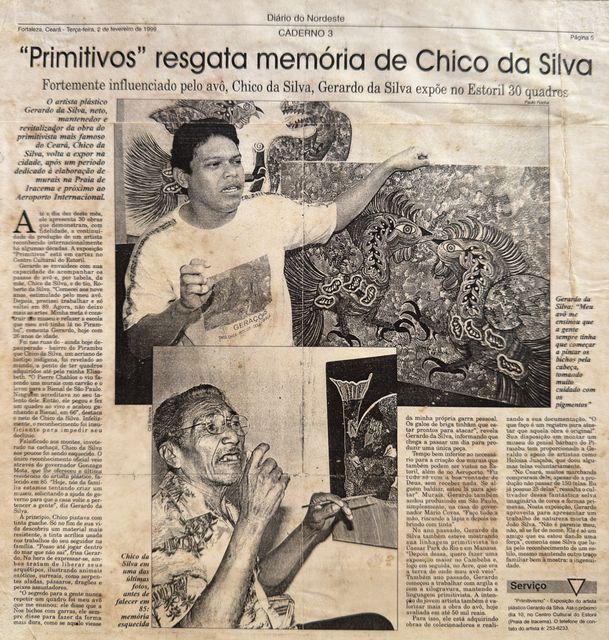
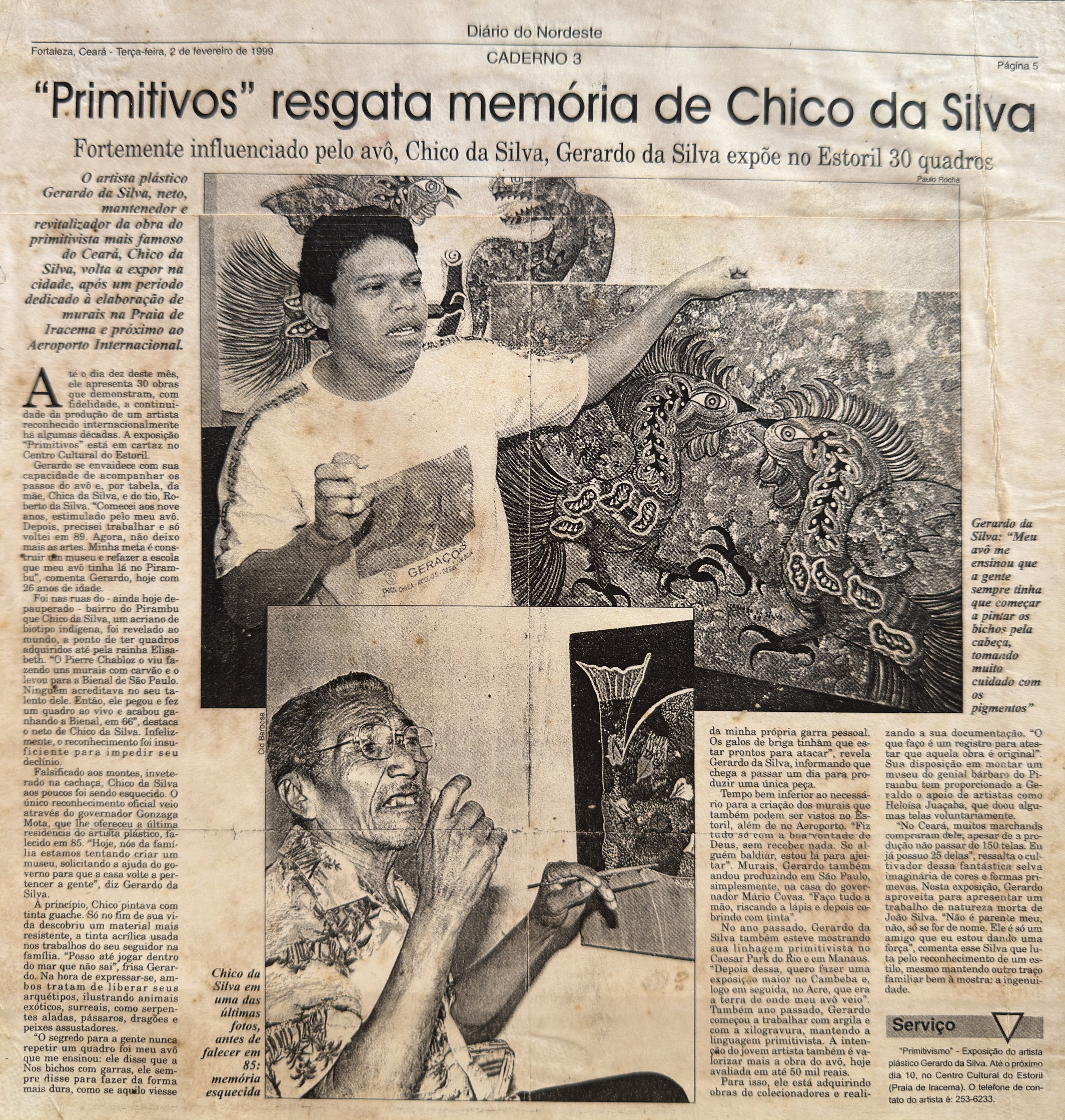
The forgetting began while he was alive. “Chico morre pouco a pouco, esquecido” (Chico is dying little by little, forgotten) was the headline O Estado de S. Paulo ran from Fortaleza in May 1976, during one of the hospital stays of his final years. After his death the printed record thins, and what movement there was came in slow steps. Revelação do Ceará, the book Jean-Pierre Chabloz wrote about his Brazilian years, appeared in 1993, published by the culture secretariat of Ceará, nine years after Chabloz’s own death. The steadiest custody was institutional: the MAUC, the art museum of the Federal University of Ceará, holds 78 of his canvases, 40 of them received in a single donation from Vera Bezerra in 2014, according to the museum’s records. The same university produced the period’s most sustained scholarship. The doctoral thesis of Gerciane Oliveira (UFC, 2015) asks in its title whether a given painting is or is not a Chico da Silva, and rests in part on 2014 interviews with surviving painters of the Escola do Pirambu. In that same 2014, the exhibition “A Realidade do Sonho”, at the Centro Cultural Banco do Nordeste, set the school in dialogue with contemporary artists from Ceará (Oliveira, 2017). The next turn had an official date: a state decree of December 2019 made 2020 the painter’s celebration year, counting 110 years from the 1910 birth, and the 71st Salão de Abril was dedicated to him; 2022 brought “Conexão Sagrada. Visão Global” at the Museu de Arte Sacra in São Paulo, the Gomide&Co solo show and the Independent Art Fair in New York (Oliveira, 2024). The outline of the life this chapter picks up from is in the biography.
High-resolution viewer. Use the arrow keys to pan, plus and minus to zoom.
High-resolution viewer. Use the arrow keys to pan, plus and minus to zoom.
Two retrospectives in one year
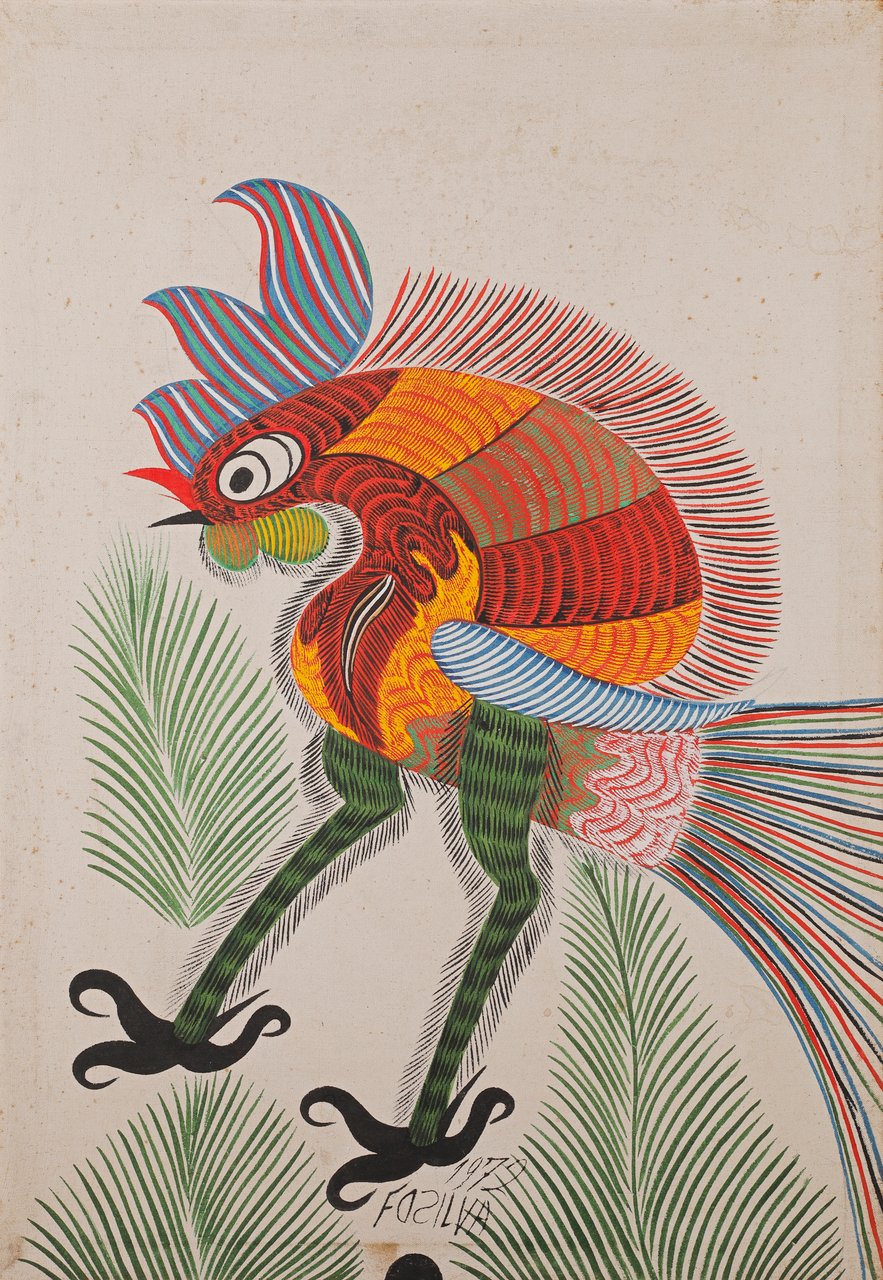
In 2023 the Pinacoteca de São Paulo mounted “Chico da Silva e o ateliê do Pirambu” (Chico da Silva and the Pirambu workshop), curated by Thierry de Freitas: 124 works and 88,881 visitors, by the museum’s own count. The show then travelled to the Pinacoteca do Ceará, renamed “Chico da Silva e a Escola do Pirambu”, with 148 works. Both titles name the collective workshop. The dispute over who painted what was public by June 1969, when O Estado de S. Paulo reported Chico’s answer to the claim that his students made his canvases; half a century later, the museums put the workshop itself at the centre of the story. In Fortaleza, the MIS-CE added “Cores que Cantam, Dragões que se Devoram”, an immersive installation built around a rarely screened film. On the walls was the repertoire he fixed in the 1960s, dragons, serpents, fish and roosters, much of it in gouache, the medium a 1970 profile in the same newspaper says Chabloz put within his reach in the 1940s.
An argument about origins
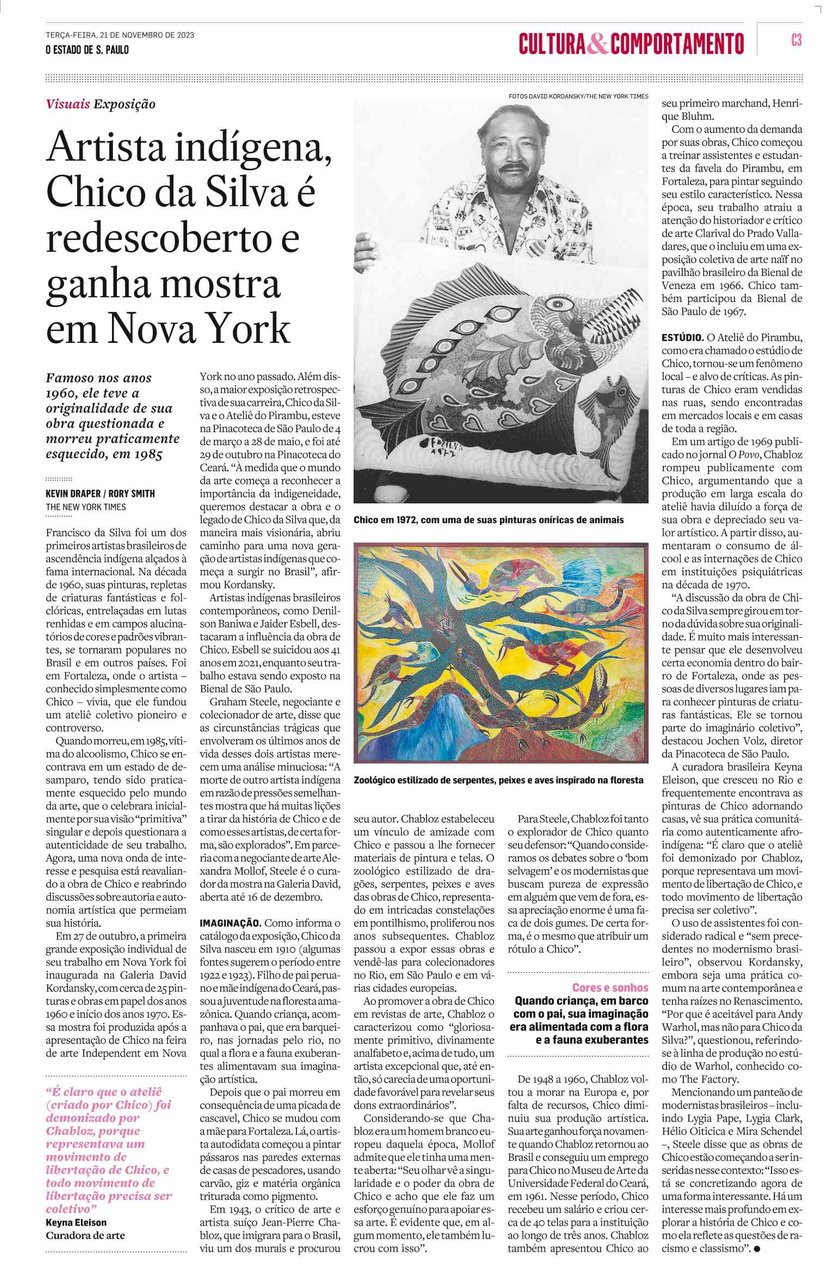
In November 2023 O Estado de S. Paulo reprinted a New York Times report under the headline “Artista indígena, Chico da Silva é redescoberto e ganha mostra em Nova York” (Indigenous artist, Chico da Silva is rediscovered and gets a New York show). The show was at the David Kordansky gallery, curated by Graham Steele with Alexandra Mollof, according to the same report. The label in the headline is the contested part. An article in the journal MODOS (Unicamp, 2024) discusses the shift under way in his critical fortune, away from the naïf and primitive labels of the twentieth century and towards indigenous and ancestral readings. The galleries that carry his work frame him in different ways: Gomide&Co, in São Paulo, presents the master of the Escola do Pirambu; Kordansky presents a pioneer of indigenous art. In the same report the dealer David Kordansky compared the painter’s use of helpers to the production line of Andy Warhol’s studio, and Graham Steele placed his work beside that of Lygia Pape, Lygia Clark, Hélio Oiticica and Mira Schendel; the piece also records that contemporary indigenous artists, among them Denilson Baniwa and Jaider Esbell, point to him as an influence. This is an argument among curators and dealers, not settled biography. The painter himself, in his lifetime, deflected the reading of indigenous reminiscence: “this is called imagination, occult sciences, astronomy”, he said in 1972; and the Macuxi artist Jaider Esbell preferred to call him a “mestizo artist” (Oliveira, 2024). The documents support less than either frame: he was born in the Alto Tejo region of Acre, on a date the sources place between about 1910 and 1922, and the 2023 coverage itself noted that the New York catalogue adopts 1910 while other sources give 1922 or 1923.
High-resolution viewer. Use the arrow keys to pan, plus and minus to zoom.
The authorship file reopens
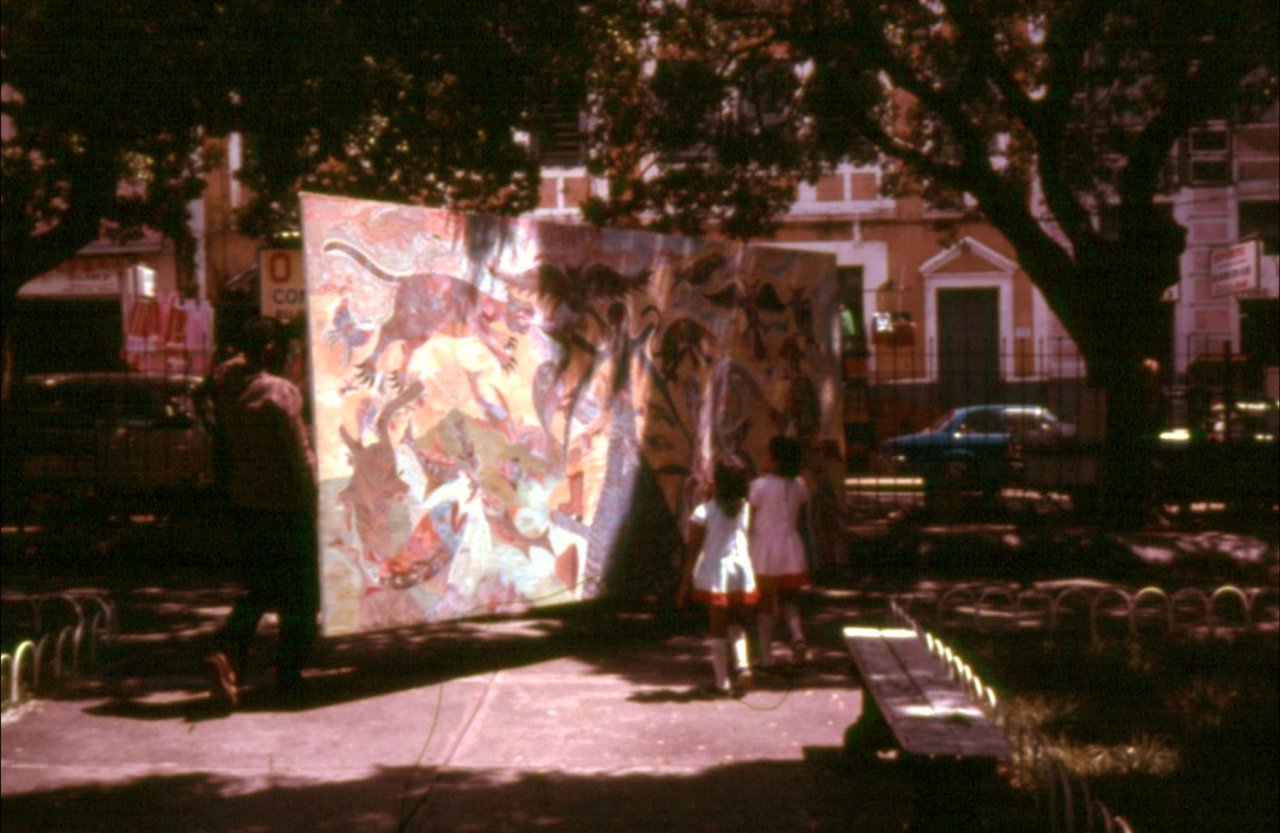
The rediscovery inherited the question the 1970s left open. In June 2023 Homens Trabalhando (Men Working), a panel painted collectively in 1977 and signed by Chico together with five painters of his circle, was formally assigned to the Federal University of Ceará through an agreement at the Federal Prosecution Service; Garcia, the only member of the group still alive, took part, as the MAUC recorded. Authentication, historically, fell to the painter’s closest relatives; Gerciane Oliveira (2017) describes the arrangement as a device for controlling market value, amid a boom the 1977 press put at two to three thousand paintings a month and that she herself, counting the undifferentiated trade, calculates at up to two thousand a week. In today’s market, she records the gradation with which galleries price authorship, from the “pure Chico da Silva” to the “Escola do Pirambu” painting, and gallerists reporting that export multiplies the values tenfold (Oliveira, 2023). Where the hand of Chico ends and where the workshop begins is the oldest question his paintings carry, and no one has closed it for good; the decade that created the problem is the subject of the painting factory.
What is on view now
Nottingham Contemporary, in England, opened what it presents as his first institutional solo exhibition in Europe on 6 June 2026, on view until 13 September. What each museum actually holds, checked against the institutions’ own records, gives a smaller and firmer map than the gallery CVs do: MAUC keeps a permanent room, built largely around the twelve Venice gouaches; the Pinacoteca do Ceará holds twenty works by him, by Garcia and by Chica da Silva; MAM Rio has two paintings in the Gilberto Chateaubriand collection, MAC USP has one, and MAR two gouaches from the 1960s. Outside Brazil, the naïf art museum in Laval, France, has Animaux fantastiques, a gouache of 1966, and the Rollins Museum of Art in Florida received Fighting Roosters, a gouache on canvas of 1974, a gift from the collection of Benjamin Ortíz and Victor P. Torchia Jr. Tate, in London, has held The Great Bird since 2022, a gouache of 1966 on plywood measuring 1.5 by 2.2 metres, on long term loan from the Tate Americas Foundation. El Museo del Barrio, which the CVs tend to list among the collections, showed two of his gouaches in 2020, lent by a São Paulo gallery.
The market followed the same curve. On 14 November 2023 Sotheby’s took Serpente da serra luminosa to auction in New York, a gouache of about 1966 on paper laid on board, 119.4 by 203.2 centimetres, estimated at 60,000 to 80,000 dollars; it sold for 330,200, the highest price ever paid for a work of his. Christie’s, Phillips and Bonhams also take his paintings to the block, in ranges far below that record: nine lots at Phillips, the highest of them at $76,200; untitled works at Christie’s, £35,280 in London and $32,760 in New York; and canvases of the 1970s at Bonhams, in London in 2024 and Paris in 2025.
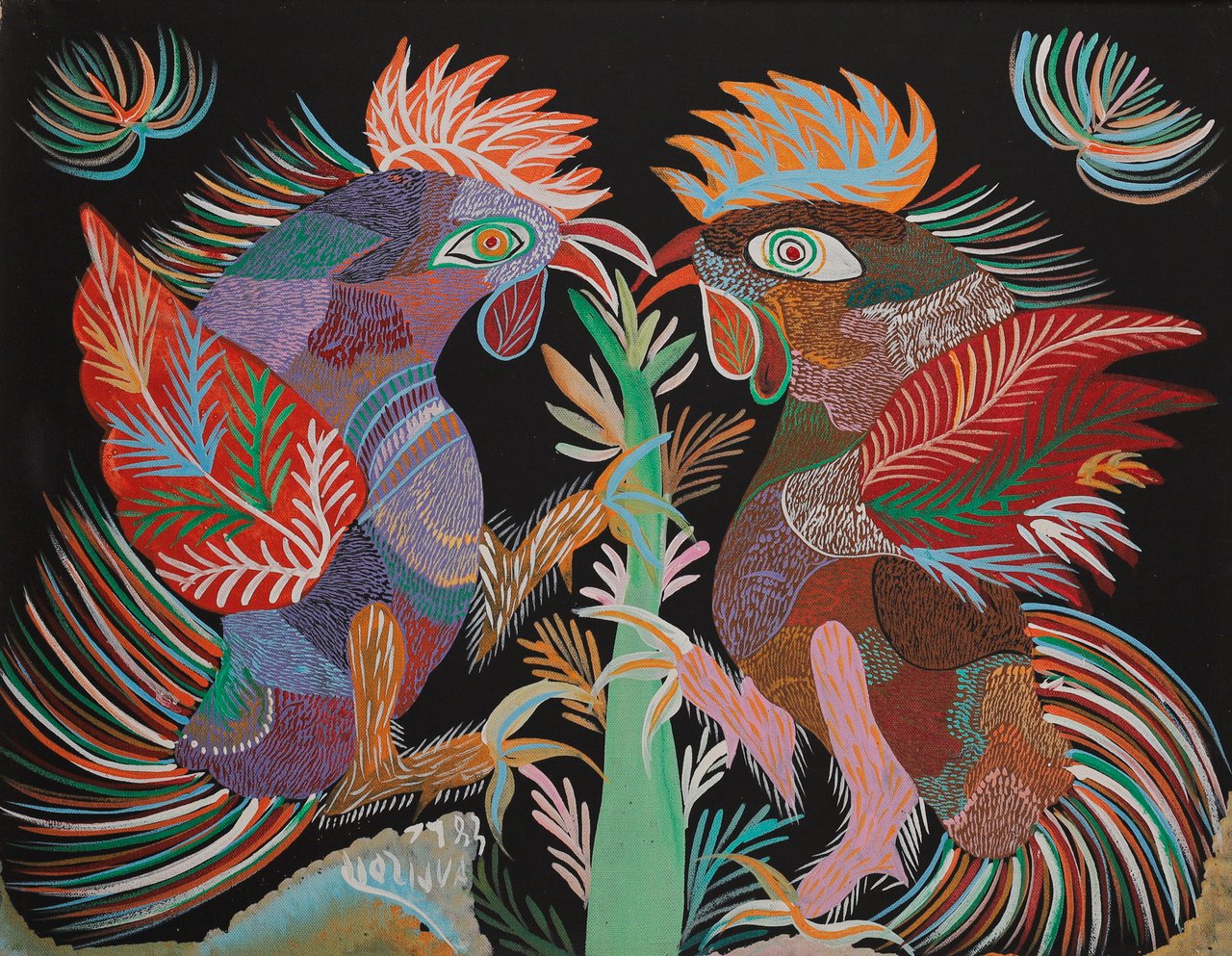
The João Cunha Collection holds paintings from across this arc, from gouaches of the classic decade to late acrylics, among them a cockfight from 1983 painted on a black ground. The works are listed in the paintings index, and the page of the collection explains how each one is documented.
Forty years after the burial at Parque da Paz, the paintings travel again, and the questions that accompanied them in the painter’s lifetime travel with them.