Primitive, Naïve, Indigenous
Eighty years of criticism on Chico da Silva, from Rubem Navarra in 1945 to the curators of the 2020s: every generation swapped the label, none settled it.
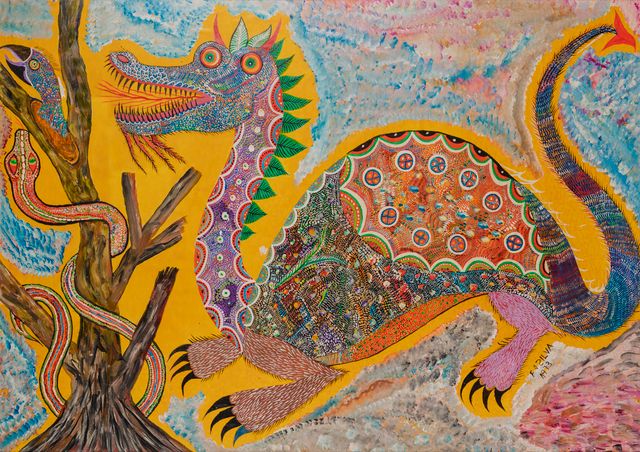
No word has stuck to this painting for long. In 1945 it was Indigenous; in the 1950s, primitive; in the 1970s, naïve, primitivist or folk, depending on the newspaper; from 2020, Indigenous again, but for reasons unlike those of 1945. What changes from decade to decade is not the work, which stayed remarkably stable across forty years. It is who is looking, and what that person needs the painting to mean.
1945: the first label arrived with an argument attached
The first national criticism came out of the group show of artists from Ceará that Chabloz put together at the Askanasy gallery in Rio in 1945. Rubem Navarra wrote the catalogue text and found the gouaches “something very serious indeed”: an example, he wrote, of what lay in potential in Indigenous sensibility, a chapter Brazilian art had yet to write. He called the painter a sort of Dalí in a state of nature.
From Fortaleza, the painter Mário Baratta answered in the columns of O Estado and disagreed with the comparison: where Navarra saw Dalí, he saw “far greater affinities” with Raoul Dufy. In the same piece Baratta founded the argument that would follow this work for the next four decades, the one about a purity that must not be contaminated. From then on, every compliment carried a condition inside it: go on being what you were when we found you.

1952: the whole cycle of Western painting
Chabloz took the gouaches to Europe and wrote about them wherever he could. In December 1952 he published in Cahiers d’Art, in Paris, an article whose title was already a thesis: “Un indien brésilien ré-invente la peinture”, a Brazilian Indian reinvents painting. The argument is that this man had travelled alone, in a few years, the cycle Western painting took centuries to walk, from archaism to the modern. In art journals he presented him as gloriously primitive, divinely illiterate and, above all, a remarkable artist who had lacked nothing but an opportunity.
The structure of that sentence is worth holding on to, because it comes back: the first two qualities are conditions of origin, and the third is merit. As long as the three travelled together, the praise worked. When origin stopped guaranteeing merit, the same author broke with him.
1966: the critic who refused the word
Clarival do Prado Valladares, who picked twelve gouaches for the Brazilian delegation in Venice, went against the current around him. In 1966 he wrote that Chico da Silva was in no way crude: he was a professional with nearly thirty years of practice. He read the painting as one man’s fixing of an oral Amazonian mythology, that is, as an author’s work on a shared repertoire rather than the spontaneous emanation of an origin.
He was outvoted. The honourable mention the jury gave that year was described by Valladares himself as the first ever awarded to a primitive painter at the Biennale, and the word stayed in the description of the prize.
1969: the yardstick the break left behind
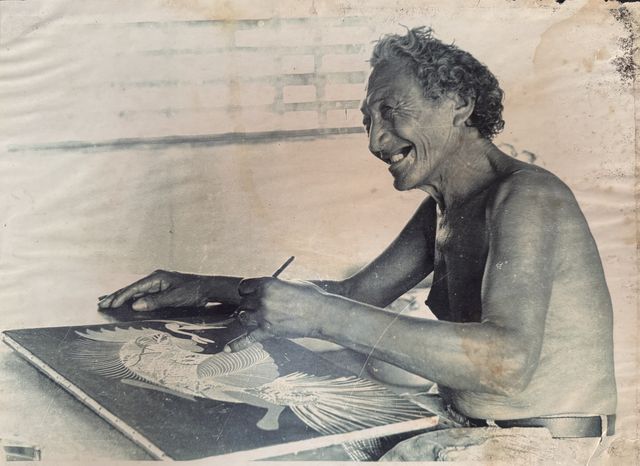
When the Pirambu workshop became public knowledge in 1969, Chabloz broke with him and took the criterion along. He began arguing that only the gouaches of his two stays, 1943 to 1945 and 1947 to 1949, resisted imitation. Eight years later Lélia Coelho Frota would save exactly that same first phase. The yardstick left criticism and entered the market, where it remains: the painting factory shows what it did to prices.
While the case was still hot, so was the comparison still most often used in the workshop’s defence. In July 1969 the critic José Roberto Teixeira Leite set the Pirambu workshop beside those of Rubens and Caravaggio, with a caveat that tends to get dropped by whoever quotes the line: those men supervised what left under their names.
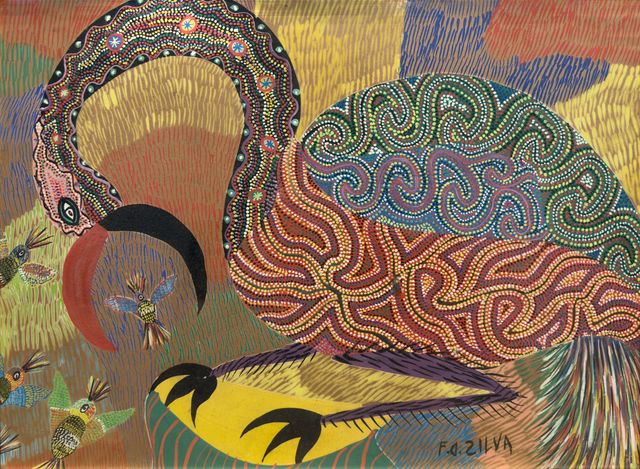
The ruler sorts by date, not by what is on the paper. Fantastic Bird and Fledglings, gouache on paper from around 1969, belongs to the phase it discards: the bird fills the whole sheet, its neck beaded dot by dot from end to end, every band of the body resolved into rows of beads.
1977: two studies side by side, opposite conclusions
The best moment in this critical history sits in a single issue of the Revista de Ciências Sociais of the Ceará university, in 1977, where two studies of the same case ran next to each other.
Lélia Coelho Frota proposed the category of liminality: the painter stood between two worlds, belonging wholly to neither. She claimed “primitive” as a positive term, and judged the late work the most extreme case of a primitive undone by the market. Already in 1977 she was writing that he no longer executed the works circulating with his name and his “supposed fingerprint” on them.
David Silberstein, who followed the circuit closely and would later take part in the collective panel Homens Trabalhando, reversed the charge. He read the case through colonialism: he explained Chabloz’s attack by nostalgia for a lost paradise, and argued that criticism had reduced the work to Amazonian exoticism, erasing what was north-eastern and urban in it. The painting had not been corrupted by the market; it had been misread from the start.
High-resolution viewer. Use the arrow keys to pan, plus and minus to zoom.
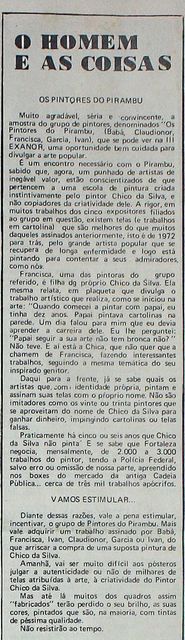
That same year the newspaper Movimento asked the shortest and hardest question of all: why is the work of Chico da Silva and the other poor painters called an industry rather than a school? The magazine Arte Hoje answered the following year that the collective character had never been a secret, and that the market preferred not to see it.
The 1970s and 1980s: four words in rotation
Outside the academy, the press alternated with little rigour between primitive, naïve, primitivist and folk. All four sometimes turned up on the same page. None of them was neutral: each placed the work in an annexe of Brazilian art, with its own rules and its own ceiling, which is why the argument over the label was never merely semantic.
From 2020: the reclassification
When museums came back to this painting, they changed the word. In 2020, Rodrigo Moura’s text for the El Museo del Barrio show expressly rejects naïve and primitive as pejorative and reductive. In 2023, Jochen Volz, director of the Pinacoteca de São Paulo, wrote that the work had for decades been superficially labelled naïve, regional and decorative. The international coverage of that year began treating the painter as a forerunner of a generation of Indigenous artists.
Along with the word, the idea of authorship changed. Thierry Freitas, who organised the 2023 exhibition, proposes replacing the primitive genius with the cultural mediator and rejects the idea of copying: every member of the Pirambu School made “Chicos”, and each of those is singular. Oswald Barroso holds that there was no forgery but a collision between collective making and a market that demands an individual signature.
The sociologist Gerciane Oliveira, who has studied the case for over a decade, calls the movement a reclassification and makes the most uncomfortable observation of the lot: it rehabilitates the painter less than it rehabilitates his condition as an Indigenous artist. She argues that neither the formal traits nor paternal descent are enough to ground the classification, above all given the artist’s own denial of tribal ancestry, and notes what the Indigenous key pushes into the background: his place in Pirambu, which is urban and peripheral ground, and the cinema and advertising references in the work, from the alligator on a kerosene tin to the monsters out of films.
Not even among Indigenous artists is the reading unanimous. Jaider Esbell, who cited his influence, referred to him as a mixed-race artist.
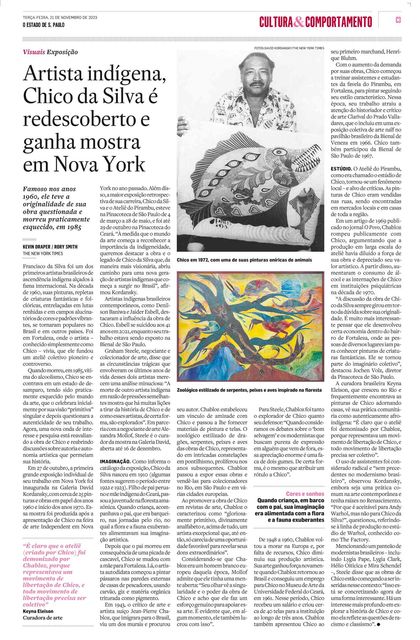
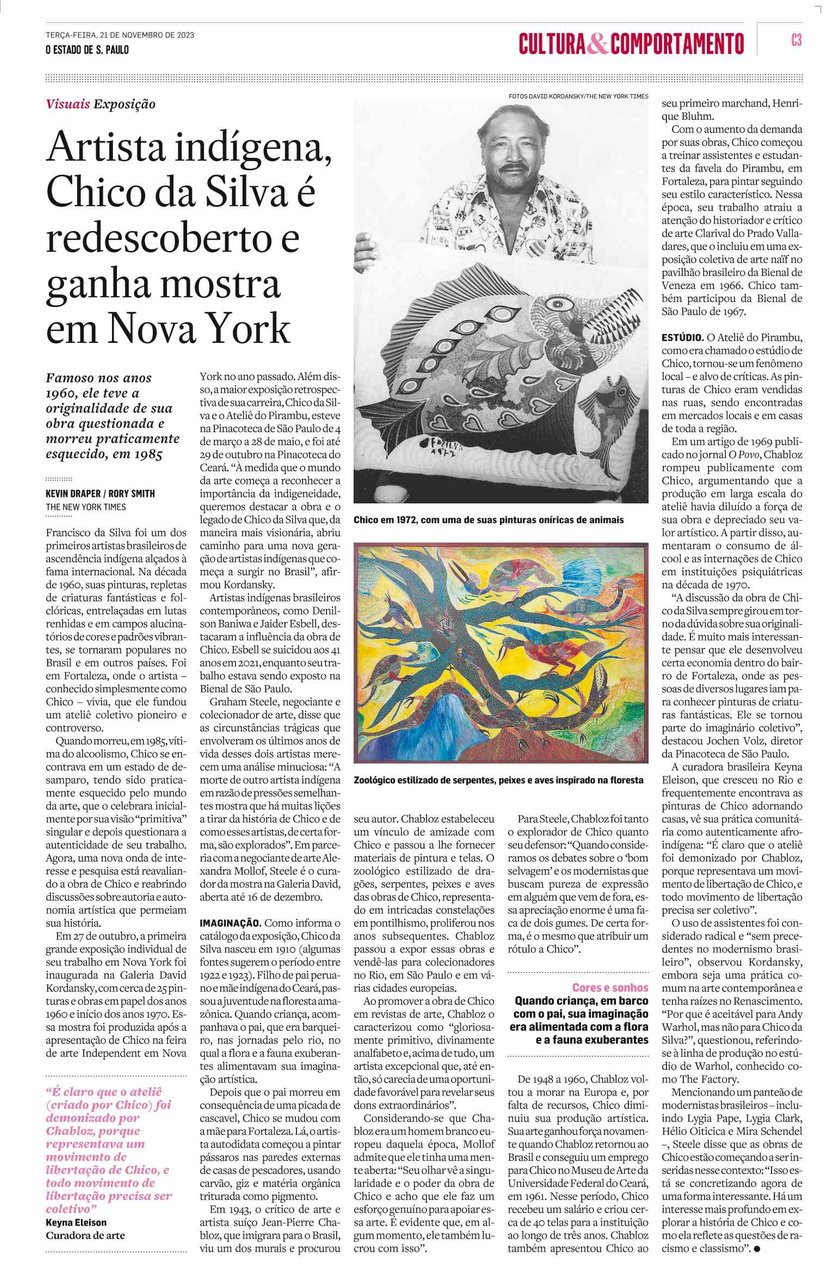
High-resolution viewer. Use the arrow keys to pan, plus and minus to zoom.
What he said himself
There is one version none of the critical schools adopted, and it is the one from the man concerned. Asked in 1972 whether those worlds were a memory of an Amazonian childhood, the reading that had followed him since 1945, he refused it: “this is called imagination, occult sciences, astronomy”. For the monsters he offered two explanations no catalogue ever quoted: he had seen them at the cinema, and he called the visions hallucinations that come with cachaça.
Eighty years of criticism and the label is still moving. The painting has stood in the same place since the walls of Praia Formosa, waiting for someone to describe it without first having to decide where it came from.