Maria Augusta, the Girl Who Signed
Maria Augusta do Carmo Moreira painted for Chico da Silva from 1965 and said so in public at fifteen: the 1969 newspapers and the canvas she signed in 1973.
Maria Augusta do Carmo Moreira signs her paintings Maria Augusta. She painted for Chico da Silva in Pirambu for about five years from 1965, and in June 1969, at fifteen, she walked into a Fortaleza newsroom and said that canvases sold under his signature were hers. The papers ran with it for two months and then let it go, and in the literature on the school she stayed as that episode: a name, an age and an accusation, never a painter. She is alive in Fortaleza and painting again. This article uses the press of 1969, the books of Roberto Galvão and Estrigas, a profile in the Fortaleza daily O Povo in November 2024 and an interview she gave the Fortaleza channel TVDD in June 2026. The João Cunha Collection holds one canvas of hers, signed and dated 25 November 1973.
The window and the charcoal
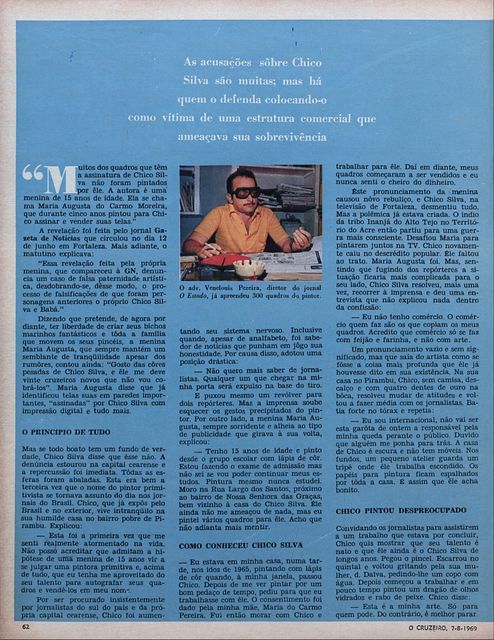
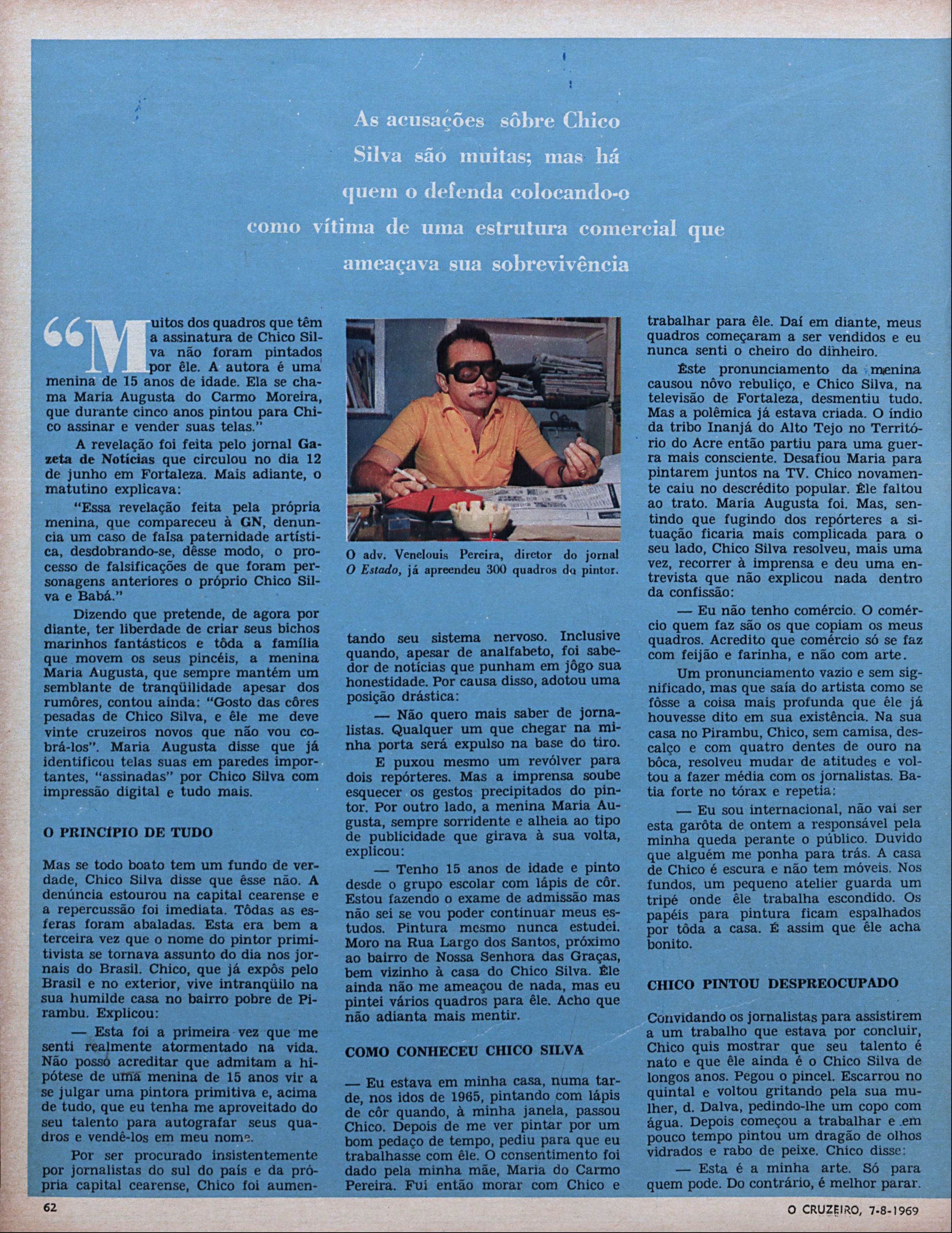
The account she gave in 1969 and the one she gives now differ in the detail and agree on the scene. In O Cruzeiro, in August 1969, she said: “I was at home one afternoon, back in 1965, painting with coloured pencils, when Chico came past my window. After watching me paint for a good while, he asked me to work with him. My mother, Maria do Carmo Pereira, gave her consent.” Fifty-seven years later, to TVDD, she puts herself on the ground at the door of the house, drawing on her mother’s walls with charcoal, and has him clap his hands to call the woman out. The 2024 profile in O Povo has the charcoal too, and adds that he asked permission to take the girl to his house and watch her paint, and that he set her mother at ease: he only wanted her to draw.
What holds the scene up is not her memory. In June 1969 Fernando Sombra, of the Jornal da Tarde, went to Pirambu and interviewed the mother, and Estrigas summarises what she said: Chico, passing the house, saw the girl painting and called her to work for him. The version told today was already the family’s version when she was fifteen.
She hears an echo in it. Chico was found drawing on the walls of Praia Formosa by the Swiss painter Jean-Pierre Chabloz, the subject of the article on the discovery, and she was found drawing on walls at home by Chico. “He on the walls with charcoal, and me on my walls with charcoal,” she told TVDD. By the age the papers give she was eleven in 1965; she remembers being about seven. O Globo says she began at eleven, with the creatures that came into her head, snakes and fish.
The room and the shed
Where she worked sets her apart. The team painted in a rented shed on Rua Nossa Senhora das Graças, and it is that shed she calls the Escola do Pirambu: Babá, Claudionor and Garcia together, with the workshop and its disputes described in the article on the Pirambu school. She worked alone, in a room of Chico’s own house. She reads it as a mark of favour, because her line came out close to his: he kept her apart in the house, she told TVDD, “with nobody but God and me painting”.
The material was the school’s. He handed her the paints, the brushes, the water and a sheet of duplex board tacked to a plank. She drew in pencil and then filled it in: “the colour was mine, all mine.” Behind the first one she put a yellow ground. She knows the vocabulary from the inside and gives it the names Garcia gives: the clichê, the stippling laid over the flat colour; the matizado, two grounds in one picture, “the sea and the dry land”; and the varnish, blown on over the gouache with a little pump, which protected the water paint and made it look like oil. Buyers took it for oil, she says. Garcia says the same, and says that a school painting in oil is false.
She watched him sign, too. Chico pressed his thumb into the paint, and in 1969 she told O Cruzeiro that she had recognised canvases of hers on important walls, signed by him “with a fingerprint and everything”. Both the Gazeta de Notícias and O Cruzeiro count about five years of work. Galvão’s chronology lists her among the newcomers to the workshop in 1966, alongside Roberto, Chico’s son, and by an error of the book makes her a daughter of the painter as well.
The paint
The paint made her ill. She turned yellow and lost weight. Her mother did not take her to doctors; a cousin who worked at the Astra brewery had the right to one and got her an appointment. The cousin was close to General Assis Bezerra, the former finance secretary of Ceará, and he came along; she remembers him noticing the stains on her hands. The doctor asked what she handled that might be poisoning her, and the cousin answered that she painted for Chico da Silva. The treatment was milk, to cut the paint.
The general knew Chico’s work, and asked the girl to paint him a picture. She said she could not. Chico had told her never to admit that she knew how to paint, or she would end up before a juvenile judge and be taken from her mother. So the general took her somewhere she could paint, and that was the newspaper.
O Globo, that June, tells the order of events the other way round: she painted a Dragon for the general first, and he then encouraged her to make the story public, without any sense of “revenge or of bringing anyone down”, as she was careful to stress. That report has her keeping quiet until then out of fear of what Chico had promised to do. In O Cruzeiro, in her own words, “he has not threatened me with anything yet”. The two accounts agree on the general as the pivot and disagree on whether there was fear.
June 1969
The Gazeta de Notícias published on 12 June 1969, under the headline “Moça Pintava os Quadros de Chico Silva”. Estrigas keeps the opening of her statement: “My name is Maria Augusta. More precisely Maria Augusta do Carmo Moreira. I am fifteen years old and I have painted since primary school, with coloured pencils. I am taking my entrance exams now, but I do not know whether I will be able to go on with my studies. Painting I never studied. I live at Largo dos Santos, near the Nossa Senhora das Graças district, where Chico Silva’s house is.”
They sat her down in the newsroom with a canvas and paints and photographed her working, which she says she only realised afterwards. When it was finished they asked her to sign. She wrote her name, which she knew how to write, and then pressed her thumb into the paint as well, because that was what she had seen Chico do and she thought that was how it was done.
Chico denied all of it. He told O Globo that he had given her some notions of drawing and painting because she was his neighbour and had introduced herself as an unconditional admirer, that he had meant to help her into a trade school, and that she had never painted a single picture for him and had no aptitude for anything resembling his work. To O Estado de S. Paulo he said that when he began painting the girl had not been born, and offered to submit to any test. Then he challenged her.
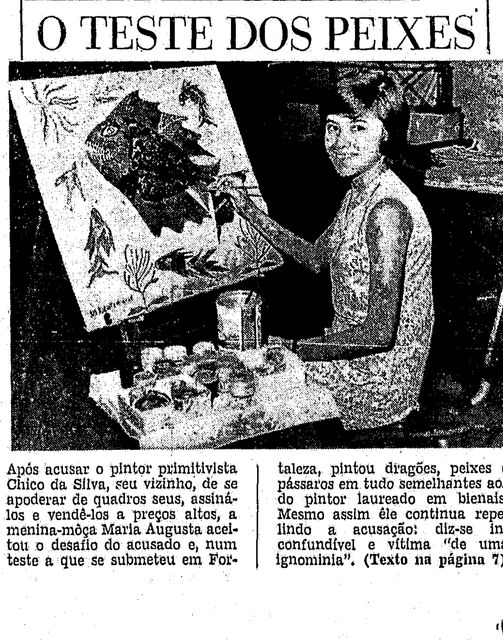
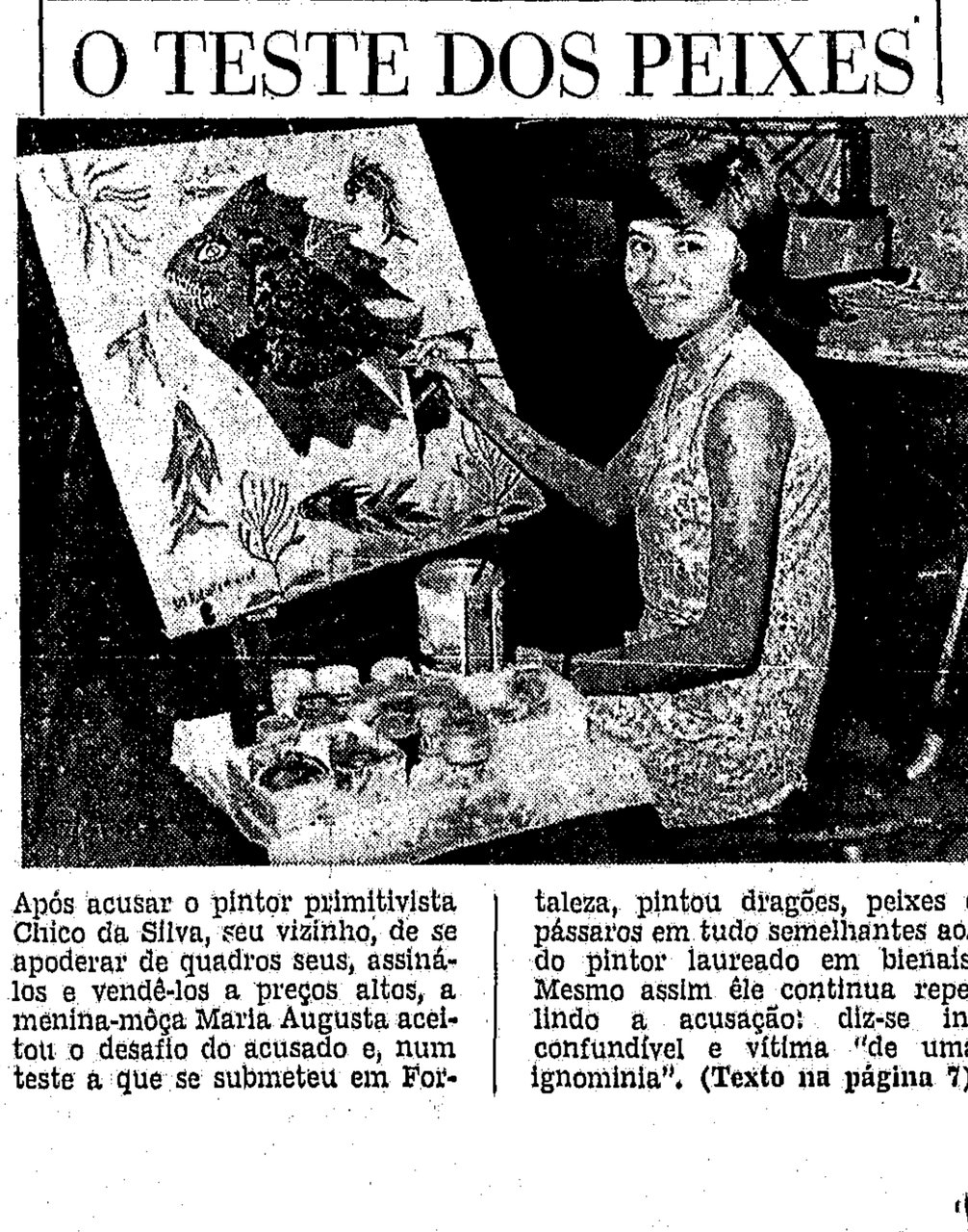
She went. He did not. O Cruzeiro is explicit in August: he challenged Maria to paint alongside him on television, “he failed to keep the appointment. Maria Augusta went.” O Globo put the test on its front page of 18 June under the title “O teste dos peixes”, with a photograph of her at the easel, and reported that she had painted dragons, fish and flying birds identical to the ones that had made his name. He went on rejecting the accusation, called it an infamy and said his style was unmistakable.
High-resolution viewer. Use the arrow keys to pan, plus and minus to zoom.
Fifty-seven years later she takes the sting out of it. The challenge was no victory over him, she told TVDD: it was like a debate the other candidate does not attend, and staying away was his right.
On money the accounts do not close. O Globo has her breaking with Chico in the second half of 1968 because the pay was minimal, two new cruzeiros for three pictures, and O Cruzeiro carries the line that has followed her ever since: “from then on my pictures began to be sold, and I never smelled the money.” In the same interview she waives what is owed: “he owes me twenty new cruzeiros, and I am not going to collect them.” Today she says he paid her mother every week, that the money kept the family and that she is grateful. Garcia, who was paid from the start, says the pay was real but small, too small to live on, which is why he left for São Paulo in 1973. What falls away is the charge of unpaid work; the amount is still in dispute.
High-resolution viewer. Use the arrow keys to pan, plus and minus to zoom.
Chabloz, who had found Chico in 1943 and by then had broken with him, gave O Povo his own reading on 30 June. Years earlier the girl had asked him for drawing lessons and, to show what she could do, brought him torn pieces of a painting close to Chico’s gouaches; pressed on it, she said she had done nothing in painting except colour in compositions Chico had scribbled. That is where every apprenticeship in the house began, in Galvão’s account of it, filling the fields inside another hand’s line.
The episode has an ending the books skip. Estrigas quotes a piece by the journalist Francisco Auto, “Vítima do Mercado”: by the second day of the exhibition in the hall of the Gazeta de Notícias, Maria Augusta had sold every work on show, at prices between thirty and sixty cruzeiros. The five painters of the original nucleus began signing their own names at the third EXANOR in March 1977. She had done it eight years earlier, by the accident of having been put out of the arrangement.
Her name on the canvas
The collection’s canvas is from four years after that month. Peixe Fantástico is gouache on canvas, forty by sixty centimetres, and the signature at the lower left reads Maria Augusta, with the date beneath it: 25-11-73. A large fish faces left with its jaws open on a magenta mouth and white teeth. Three discs sit along the body, each a black centre inside rings of yellow and red, with white lashes radiating from them like small suns. The black of the body is worked over in stippled spirals, the clichê she described to TVDD, and the fins open above and below in fine green, blue and red. Five clumps of the same green seaweed stand around it.
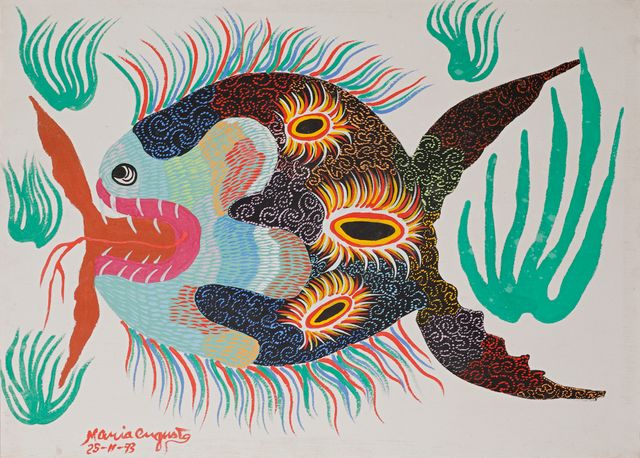
A canvas from the school signed by the disciple and dated while Chico was alive is rare, because the arrangement was that Chico signed. She kept painting the same bestiary he had put in front of her, and it is her hand and her name.
What came after
The invitations came after 1969. She was asked to the Escola de Belas Artes in Rio de Janeiro. The actress Bibi Ferreira sent a plane ticket so that she could paint on her television programme. She did not go: her mother would not fly, and she was too young to travel alone. She thinks a career might have gone further if she had. She exhibited in Fortaleza and she sold. The Colégio Batista Santos Dumont bought the materials for some fifty canvases and put on a show that sold out, with the painter Barrica looking after the hanging and the prices; the school kept a painting of hers in the entrance hall, and one canvas of that period, dated 1998, stayed with her. She paid for her brother Aristides’s schooling out of what the painting brought in.
Her mother died in 1995 and she stopped. “I could not put anything on the canvas any more, because it made no sense to me if she was not with me,” she told O Povo. She went to work cleaning houses in Passaré, on the other side of Fortaleza, and lived on that. In one of those houses she met Margarida Garcia, who goes with her now and whom she calls a granddaughter.
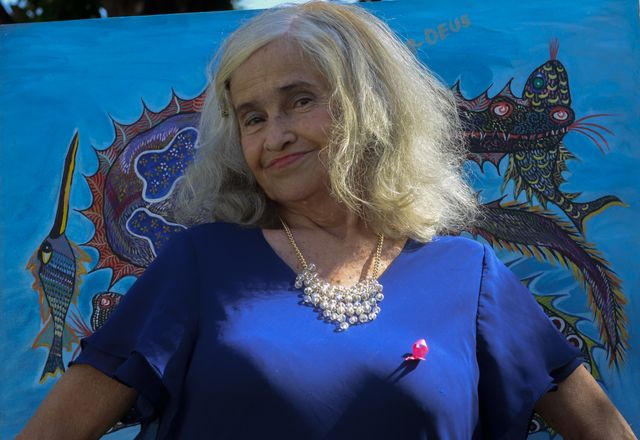
She paints again. What she showed TVDD in 2026 is from 2025: a dragon with its young, and a flower, which she says is her own mark on the school’s bestiary. The flower is there to say the dragon is tame. Of the word the critics used for all of them she has her own reading, which she offered the interviewer before he could ask: primitivista comes from prima, as in obra prima, a masterpiece, and from vista, because you see it. Her canvas is in the index of paintings, in the section of what a disciple signed while the master was alive.