Chico da Silva painting appraisal and authentication
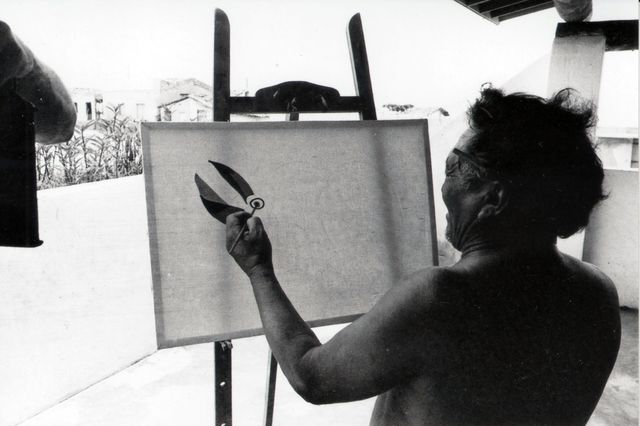
There is no price list that tells you whether a painting signed Chico da Silva is his, or what it is worth. The same signature appears on works painted by the master alone, on works made by several hands in the house in Pirambu, and on canvases he never saw. Telling one from the other takes an appraisal by someone who looks at the front, the back and the history of each painting. If you own a Chico da Silva, or think you do, request an appraisal.
Who painted it?
This is the first question, and the hardest. In the 1960s and 1970s, the Pirambu disciples drew the outlines and filled in the color, and Chico finished the work, corrected it and signed it. In 1965 the dealer Henrique Bluhm opened a workshop outside his house, where others painted and Chico came by to sign, and more workshops followed (Galvão, 1986). By Roberto Galvão’s count, about 90% of the works in circulation came out of the Pirambu School.
So a painting with this signature can have very different histories. Some works were painted by Chico alone, some with the help of his assistants, some by the assistants and signed by him, and some painted and signed by the disciples themselves, who in the 1970s began to use their own names. There is almost never a document that says which of these hands a painting came from.
And then there are the fakes. In 1976 the Jornal do Brasil estimated that nine out of ten Chico paintings made after 1972 were fake. The F. D. Silva signature, with its mirrored letters, and the thumbprint in the paint were imitated early: in 1972 the critic Luiz Ernesto Kawall was already describing fake canvases sold at the doors of Fortaleza’s hotels with the “reversed D” and the thumb stamp. And the forgers are still at work: with Chico’s return to museums and auctions in the 2020s, told in legacy and rediscovery, his paintings rose in value, and new copies came with them. The painting factory tells how this production grew.
Same subject, same painter
The two cockfights below are by Chico da Silva and belong to this collection. The first is from 1969, gouache on paper mounted on Eucatex board. The second is from 1983, acrylic on canvas.
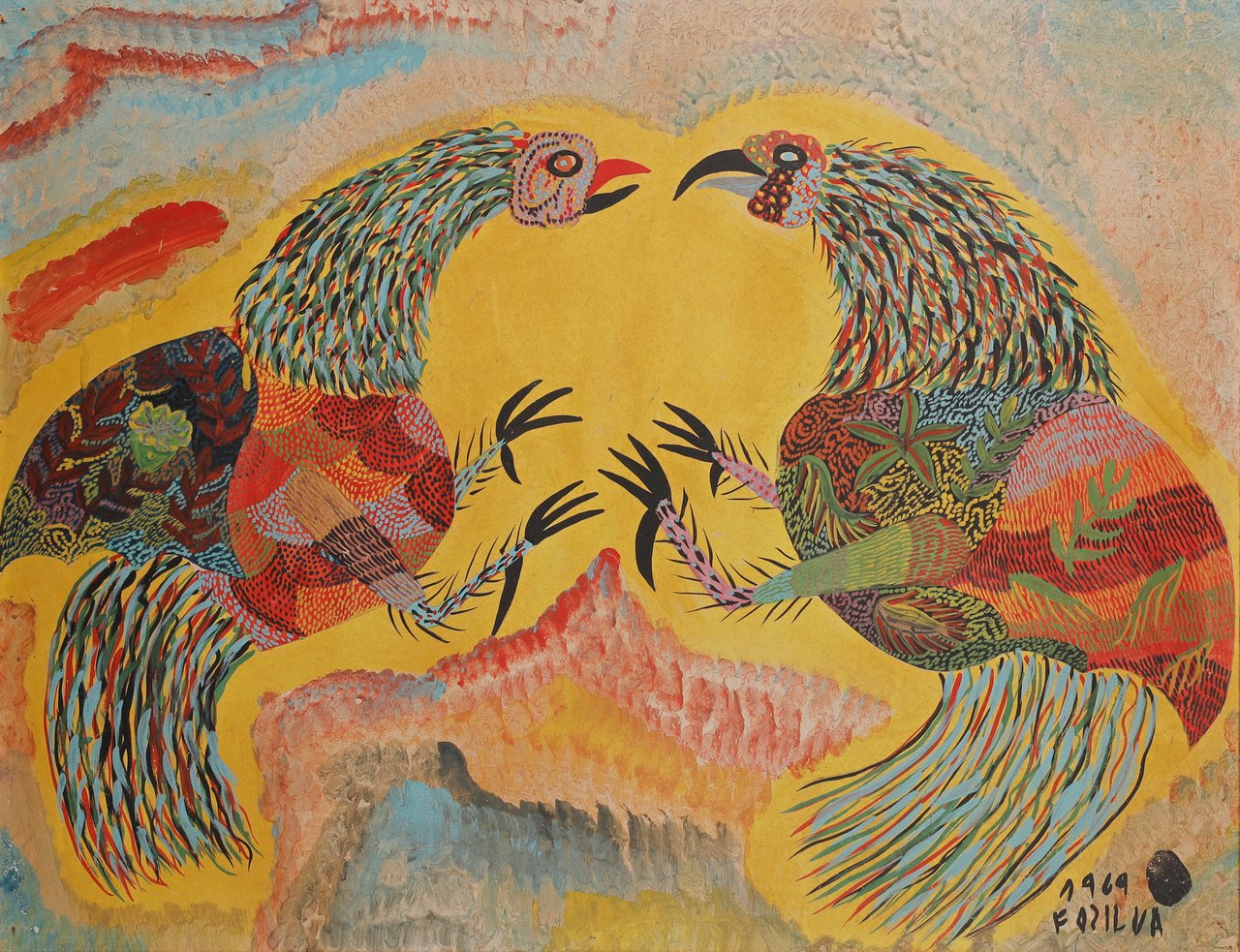
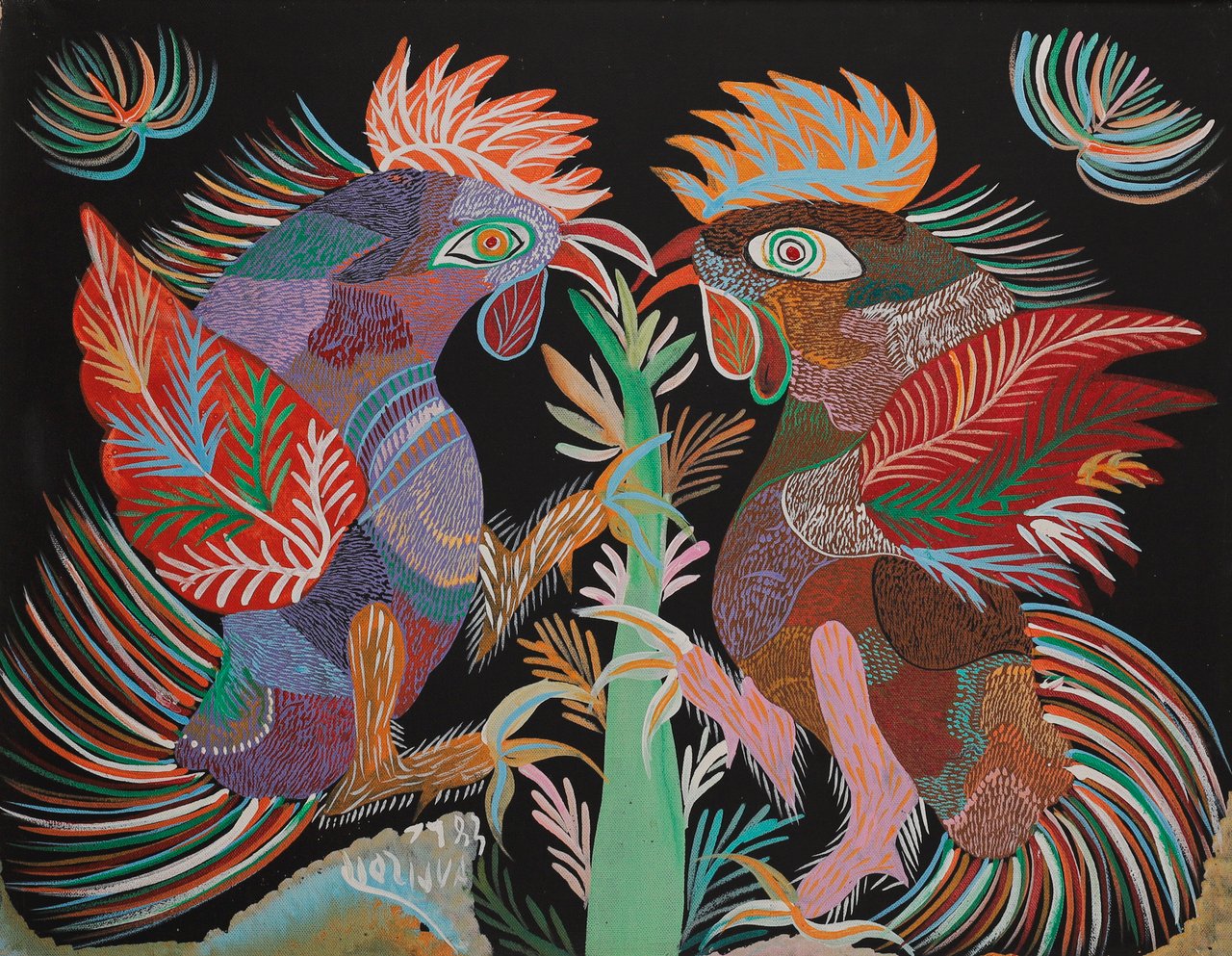
Notice how different the signatures are, and the line, the color and the background too. The subject is the same, and so is the author, yet the two paintings barely look like the work of one painter. Chico’s work changed from phase to phase, and that variation is part of what makes it hard to recognize one of his paintings by its looks alone.
Material, date and subject
Until around 1970, Chico painted mostly in gouache on paper and card. Canvas and acrylic arrived with the workshops, because they were quicker to work with (Galvão, 1986). The gouaches of the 1940s, from the years when Jean-Pierre Chabloz introduced the painter to the public, are another chapter. A support or an animal common in one decade can be rare in another, and a well-painted picture can carry a date that does not match its material.
Size, composition and condition also count, and each one changes how the others are read. Gouache on paper suffers from damp and light, and fading, cracking and paint loss weigh on the value of a painting.
Why an appraisal matters
Two paintings with the same signature can be far apart in value, and auction houses already record the difference in their catalogues: some lots are sold as “Chico da Silva” and others as “Chico da Silva (Pirambu School)”. Galleries, auctioneers and museums want authorship and provenance worked through before they accept a work. To sell, insure, divide an inheritance or donate, the first step is to understand what the painting is.
Provenance matters too: who bought it, from whom, when and where. An exhibition label on the back, an old receipt, a photograph of a room with the painting on the wall, a reproduction in a newspaper or catalogue. Keep everything you have.
How to request an appraisal
We offer a professional appraisal service for paintings by Chico da Silva and the Pirambu School, for people who inherited or bought a work and also for galleries, auction houses and collectors. To request yours, write to inquiries@chicodasilva.org and send:
- a photograph of the whole front, in good light, with and without the frame;
- a photograph of the back;
- a close-up of the signature;
- the dimensions, without the frame;
- the technique and support, if you know them;
- what you know of the painting’s history, and photographs of any labels, receipts or certificates.
The photographs and details you send are not published without your permission.
Frequently asked questions
How can I tell if a Chico da Silva painting is authentic?
No single sign settles it. The signature with mirrored letters, the thumbprint pressed into the paint, the certificates and the labels on the back have all been imitated, some as early as the 1970s. At the same time, authentic paintings of the same subject change a great deal from one phase to the next. The answer comes from the whole: the painting, the material, the date, the back and the painting's history, compared with works of known origin.
How much is a Chico da Silva painting worth?
The hardest part is knowing whether the painting is authentic and whose hand painted it. Even among authentic works, values range from hundreds of dollars to tens of thousands, depending on the phase, the support, the size, the subject, the condition and the provenance. That is why the value of a painting can only be estimated after looking at it.
Is a Pirambu School painting a fake?
No. Chico's disciples, such as Babá, Claudionor, Garcia, Ivan de Assis and Chica da Silva, the painter's daughter, learned in his house and went on to sign with their own names. In 1977 the Correio do Ceará reported an exhibition of the five at the III EXANOR, each with their own signature. A painting by one of them is their own work and has its own market. The difficulty lies in the paintings where the hands are mixed.
Does condition change the value?
It does. Gouache on paper and card suffers from damp and light, and many paintings from the 1960s and 1970s have come down to us faded, cracked or with paint loss. Canvases stored rolled up, frames that touch the paint surface and old restorations also count. Close-up photographs in good light help show the condition before anything else.
Is a painting with a certificate authentic?
Not necessarily. The 1970s brought certificates registered at a notary's office and notarized signatures on the backs of canvases, and those papers were copied too. A certificate is a lead to follow, like a gallery label or an old receipt, and it is worth what can be confirmed from it.
Do you also appraise paintings by the disciples?
Yes. The appraisal covers paintings by Chico da Silva and by the painters of the Pirambu School, including those with a dual attribution and those that arrived with no information at all.