Art and artists
Naïve art, art brut and art singulier: differences
The history and disagreements behind naïve art, art brut and art singulier, with paintings by Rousseau, Lesage, Séraphine Louis and Chico da Silva.
In 1938, New York’s Museum of Modern Art brought European and American painters together under the title Masters of Popular Painting: Modern Primitives of Europe and America. Eleven years later, Jean Dubuffet published L’Art Brut préféré aux arts culturels to accompany an exhibition in Paris. The MoMA title presented these modern primitives as masters; Dubuffet’s declared a preference for art brut over established art. These are different critical proposals, preceding many definitions now circulated as though they formed a settled vocabulary.12
Naïve, brut and singulier appear in museums, galleries and books to bring together work that schools and salons have not always recognised. Understanding the distinctions requires asking who assembled the work, when and according to which criteria. A self-taught artist can appear in more than one of these histories. The chosen word changes what people intend to show about that artist.
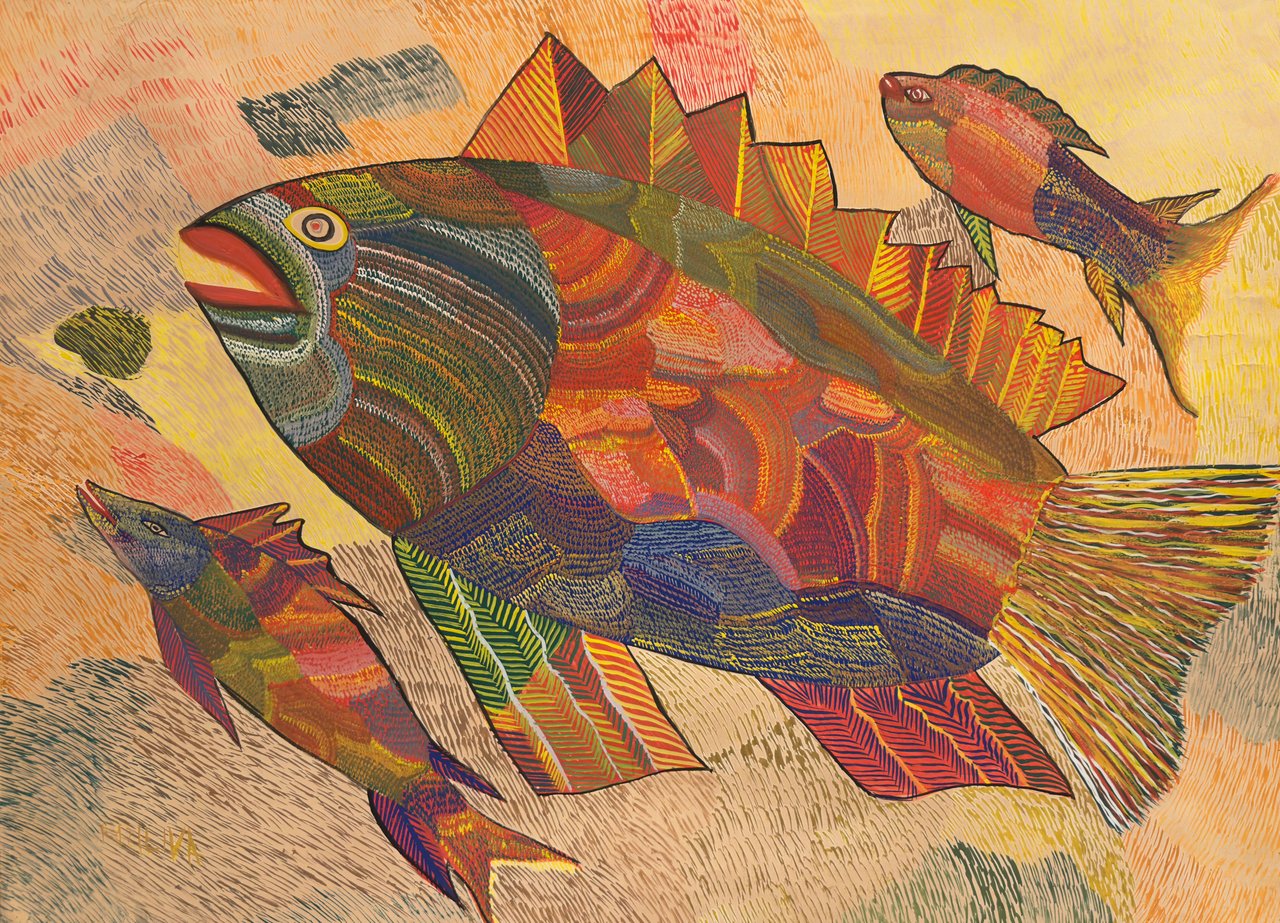
In Chico da Silva’s Fish, from around 1966, a large body crosses the sheet between two smaller fish. Rows of tiny marks follow its flank; triangular fins divide into red and yellow fields. The image allows us to recognise the animal while following a design repeated in several directions. Nothing in that observation alone settles whether naïve is the best name for the painting. The word requires a history of reception, discussed in Primitive, naïve, Indigenous. Here the question is why the categories come together and then separate.
The problem with calling a painting innocent
In everyday usage, naïve suggests innocence. Applied to painting, that meaning can make a reader imagine an artist who does not understand what they are doing. Henri Rousseau’s career shows the scale of the misunderstanding. He was self-taught, wanted institutional recognition, submitted paintings to salons and looked at official painting. The Musée de l’Orangerie made this ambition the subject of its 2026 exhibition.3

Henri Rousseau, Tropical Forest with Monkeys, 1910. Oil on canvas, 129.5 × 162.5 cm.
Henri Rousseau. National Gallery of Art, Washington, John Hay Whitney Collection, 1982.76.7. Reproduction: NGA; photographer not identified in the record. National Gallery of Art record.In Tropical Forest with Monkeys, leaves have separate contours and overlap like cut pieces. The orange monkey below occupies a space of its own before the vegetation, while others hang among stems. Large pale flowers cross the foreground. The limited modelling of volume and the changes of scale belong to the canvas’s organisation.
Rousseau did not travel to the forests he painted. The National Gallery of Art connects these images with gardens, the Paris zoo and printed sources.4 The forest was constructed from observations and recomposed images. Learning outside the academy had its resources and routes; the absence of a diploma does not describe that work of composition.
Martine Lusardy, director of the Halle Saint-Pierre, proposes distinguishing naïve art through its relationship with established painting genres, subjects and techniques. In her 2019 interview with the Académie des beaux-arts, she even describes representation in this field as awkward.5 That qualification belongs to her interpretation. In front of Rousseau, we can describe more precisely what happens: shallow perspective, plants concealing other plants and carefully separated areas of colour. The category locates a reception; a judgement about the painter’s ability needs to face the canvas.
Dubuffet selects a distance from artistic culture
From 1945, Dubuffet collected work in pursuit of a creativity he imagined free from cultural conditioning. His research trips in Switzerland included psychiatric hospitals and encounters with doctors interested in their patients’ work. Aloïse Corbaz and Adolf Wölfli entered this history. The project acquired its own organisation, exhibitions and writing, including the 1949 manifesto.2
The difference from naïve art lies in the purpose of the selection. Dubuffet sought inventions whose procedures and aims escaped established artistic models. A lack of academic training was only part of the question. Painting a familiar landscape with unusual perspective could remain within established genres; inventing a personal system of images, writing or objects opened a different enquiry.
This does not turn medical diagnosis into an aesthetic definition. Dubuffet’s research included psychiatric institutions, but art brut concerned the relationship between the work and artistic culture. Each maker’s history, the uses of the work and its route into a collection participate in its classification. A surface filled with tiny signs is insufficient to identify it.

Augustin Lesage, Composition, around 1930. Oil on canvas, 70 × 49 cm.
Augustin Lesage. LaM, Villeneuve-d'Ascq, 999.32.4. L'Aracine donation, 1999. Photograph: Cécile Dubart. LaM collection record.Augustin Lesage prevents a simple division between isolation and public life. A former miner, he said that spirits guided his painting, and his work is represented in the Collection de l’Art Brut. He received patronage, showed a painting at the spiritualist congress in Paris in 1925 and exhibited at the Salon d’Automne in 1926.67
The symmetrical rows of his Composition permit a formal reading, but his place in art brut does not follow from a visual formula. His explanation of the work and his background entered the selection. Public recognition coexisted with the mediumistic origin he attributed to his paintings. The situation is more complex than an image of a maker entirely unaware of any audience.
An ideal and the works that resist it
Lusardy draws attention to this difficulty: in her view, Dubuffet’s imagined ideal art brut maker may never have existed. She proposes degrees and poles in place of immovable boundaries. Her interpretation moves away from a test of purity that could be applied mechanically to every biography.5
The collection itself devised a solution for works that fell outside its stricter criteria. The Collection Annexe, established in 1962, was renamed Neuve Invention in 1982. It brought together professional artists at odds with the cultural establishment and self-taught makers whose work circulated through traditional art channels.2 The existence of this group reveals an institutional choice: certain works remained close to art brut under a different designation.
The museum that opened in Lausanne in 1976 also changes the conditions of reception. Works sought for their distance from the art world come to be conserved, studied and exhibited by an institution. That contradiction belongs to the history of the term. Consulting a collection and its dates is more useful than trying to guess a classification from an image’s appearance.
Singulier: widening the exhibition field
The phrase art singulier spread following Les Singuliers de l’art, held at the Musée d’Art moderne de la Ville de Paris in 1978. Returning to this history in Singuliers théâtres in 2023–2024, the Musée Paul-Dini states that the name defines neither a movement nor an artistic current or style.8
The museum brings together artists with different backgrounds and practices. The exhibition included the environment builder Facteur Cheval, Gaston Chaissac, Anselme Boix-Vives and Armand Avril. Looking for a common identifying technique would overlook the diversity that prompted the grouping.
Paul-Dini also records that Dubuffet encouraged other collectors to invent names for their holdings to distinguish them from his collection. In that setting, singulier allowed related works to be exhibited without accepting every criterion of brut. The names also describe initiatives by collectors and curators, their encounters and disagreements. These are not three styles a painter might choose to learn in succession.
Séraphine and a change of view

Séraphine Louis, L’Arbre de vie, 1928. Oil and Ripolin on canvas, 144 × 112 cm.
Séraphine Louis. Musée d'Art et d'Archéologie de Senlis, A.00.6.187. Photograph: Christian Schryve, reproduced by the Pays d'art et d'histoire. Musées de Senlis record.Lusardy names Séraphine Louis among artists once classified as naïve and later perceived as closer to art brut.5 That change does not correspond to repainting the canvas. It changes the attention given to invented procedures, relationships with existing models and the artist’s life.
L’Arbre de vie retains a recognisable tree, with trunk, roots and a crown filling almost the whole canvas. Leaves have pale centres and red or blue tips; small marks spread between them. Oil is combined with Ripolin, an industrial paint. The Musées de Senlis record states that Wilhelm Uhde and his sister, former owners of the painting, chose the title to give it a sacred dimension.9
Even the name under which we encounter this work involves a later act of interpretation. “Tree of life” directs a search for religious meaning; the medium draws attention to materials; naïve and brut open other histories of viewing. Before the same tree, each piece of information leads to different questions. Knowing who made that choice, and when, allows us to discuss the label without taking its judgement as a natural property of the painting.
Notes
-
The Museum of Modern Art. Masters of Popular Painting: Modern Primitives of Europe and America, exhibition archive, 27 April–24 July 1938. ↩
-
Collection de l’Art Brut. Historique, entries for 1945, 1949, 1971, 1976 and 1982. Formation of the collection and Neuve Invention. ↩ ↩2 ↩3
-
Musée de l’Orangerie. Henri Rousseau, l’ambition de la peinture, exhibition, 25 March–20 July 2026, sections “Introduction” and “L’ambition de la peinture officielle”. Naïve reception and the pursuit of recognition. ↩
-
National Gallery of Art. Tropical Forest with Monkeys, 1982.76.7. Collection record, visual sources and spatial analysis. ↩
-
Nadine Eghels. L’art brut enrichit notre présence au monde, interview with Martine Lusardy, Académie des beaux-arts, Lettre no. 90, summer 2019. Answer on the distinction between naïve art and art brut. ↩ ↩2 ↩3
-
Collection de l’Art Brut. Lesage, Augustin, biography. LaM, Composition, 999.32.4, around 1930, oil on canvas, 70 × 49 cm. ↩
-
LaM. Les Mystères de l’Antique Egypte, “Notice”. Jean Meyer’s patronage, the 1925 congress and the Salon d’Automne in 1926. ↩
-
Musée Paul-Dini. Singuliers théâtres, exhibition, 21 October 2023–11 February 2024. History of the term, range of practices and exhibited artists. ↩
-
Musées de Senlis. Séraphine Louis, L’Arbre de vie, A.00.6.187. Medium, dimensions and the choice of title. Reproduction and photograph credit: Pays d’art et d’histoire de Senlis et Ermenonville. ↩