Art and artists
Unica Zürn: drawings, anagrams and changing faces
In Unica Zürn's drawings, a line can belong to several faces. Three works reveal how eyes, empty spaces and ink turn one creature into another.
An anagram allows another sentence to be written with the same letters. Every letter in the sentence must be used again, including its repetitions, in a different order. Unica Zürn (1916–1970) made this practice a form of poetry. In Hexen texte, published in Berlin in 1954, anagram poems and etchings already shared a book.1
In her drawings, a line can also take part in more than one figure. An eye meets another forehead; the curve of a nose continues towards a mouth belonging to another face. The affinity with anagrams lies in this ability to rearrange recognisable elements. It is a way of reading the images, without assuming that each sheet was planned as a poem.
Zürn wrote short stories published in the German press and, in Paris, knew artists and writers in the Surrealist group.2 In the works gathered here, no illustrated story waits simply to be deciphered. Each act of recognition opens a new difficulty.
Whose eye is this?

Unica Zürn. Untitled, 1965. Ink and gouache on paper, 65 × 50 cm.
Reproduction: AWARE. Courtesy Ubu Gallery, New York, and Galerie Berinson, Berlin. Photographer and owning collection not identified in the record. Record and reproduction at AWARE.For a moment, the large eye at the upper right seems to organise the head drawn in 1965. There is an extensive forehead above it and lines suggesting the side of a face. Below, however, another eye points in a different direction. On the left, a long profile crosses the composition; in the centre, a smaller nose approaches a mouth full of teeth. Several faces can be assembled, yet none can account for all the parts.
The strangest things happen where the lines intersect. A contour we had been following as skin passes through another face and remains visible. No opaque surface conceals what lies behind. Zürn retains several possible faces at once, as though their walls were transparent. The large outer curve contains them all, while the interior remains divided between incompatible directions.
She also distributes the work of the line unevenly. Broad, almost empty spaces lie over the forehead. Scales, small circles and parallel lines accumulate near the eyes. Passing between these areas makes a single curve seem longer still, and a narrow band of marks appear thick. The drawing acquires weight without filling everything with black.
This way of dividing a figure becomes clearer alongside Untitled, painted by Chico da Silva in 1972.
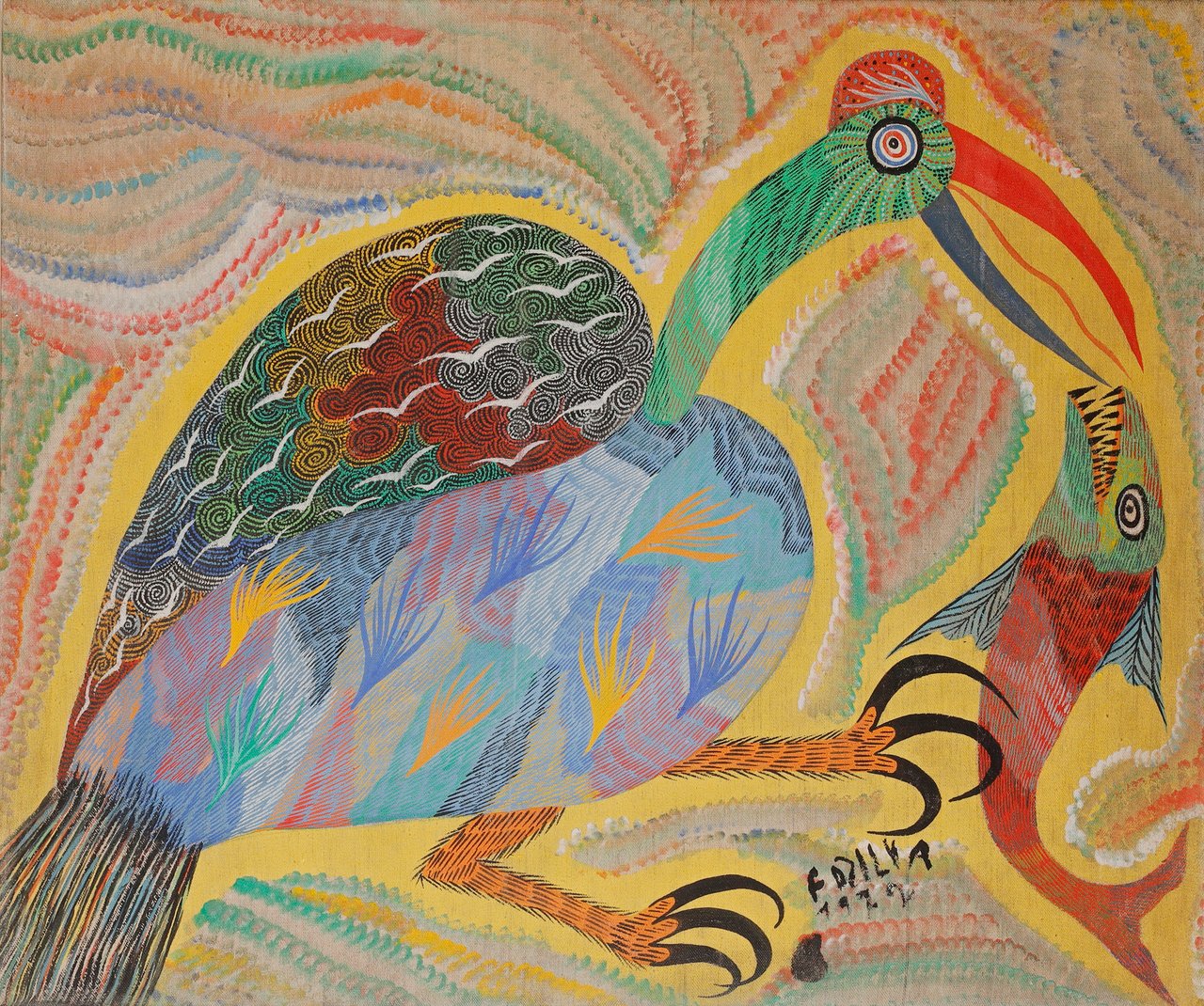
The larger animal’s enormous beak almost touches the head of the small creature on the right. It is a cramped encounter, but two eyes and two contours allow each body to be followed. Spirals on the back and lines across the belly change pattern within areas already bounded. With Zürn, the difficulty arises earlier: following one profile can deliver us to another’s mouth or eye. The comparison clarifies what is at stake in the 1965 sheet, where recognising an individual does not end the search for others.
Paris and automatic drawing
Zürn moved to Paris with Hans Bellmer in 1953. In 1959 she participated in Eros at Galerie Daniel Cordier; in January 1962 she had an exhibition of drawings and gouaches at Le Point Cardinal.3 Her visual work circulated through exhibitions and publications alongside her writing.
The Michael C. Carlos Museum identifies automatic drawings among her works.1 The term belongs to Surrealist experiments in allowing a line to proceed without a completely predetermined subject.4 Looking at a finished sheet reveals the encounters this procedure makes possible, but not the order in which every mark was made. A forehead may fit a curve later; the final image holds the fit, not a film of the gesture.
Black opens holes

Unica Zürn. Untitled, 1963. Ink on paper, 64.8 × 49.5 cm.
Reproduction: AWARE. Courtesy Ubu Gallery, New York, and Galerie Berinson, Berlin. Photographer and owning collection not identified in the record. Record and reproduction at AWARE.The creature drawn in 1963 has a different humour. At the top of a long neck is a head turned towards the left, with two eyes and a dark mouth that seems open. A large black mass occupies the upper right. Inside it lies a small white oval: an empty shape functioning almost as another eye.
This device recurs across the body. Between scales and fine lines, black patches contain pale slits; in places they resemble sliced seeds. It is hard to decide whether we see a marking on the skin or an organ. By retaining paper within black, Zürn makes a detail look illuminated and hollowed out at once.
The lateral extensions move at another pace. One crosses the left margin like a stem; the one on the right thins almost to a thread. The lower part unravels into curling points, some pale, others full of lines. The centre, loaded with small patterns, is suspended between very light extremities.
The surrounding paper contributes to that suspension. There is enough room for the large head to lean without meeting another object. The body’s curve rests on no ground; it turns back into itself. The contrast between the almost comic face and details resisting any name keeps the creature unsettling even after its silhouette has become recognisable.
A figure reaching towards the edges

Unica Zürn. Untitled, 1959. Ink and gouache on paper, 45.1 × 61.9 cm.
Reproduction: AWARE. Courtesy Ubu Gallery, New York, and Galerie Berinson, Berlin. Photographer and owning collection not identified in the record. Record and reproduction at AWARE.In the 1959 drawing, colour enters through small signs. Yellow and red squares appear between marks; pinkish lines run through certain areas without covering the paper. The greatest concentration is near the centre, where two dark rounded shapes can be read as eyes. On the right, a very broad mouth or beak opens within fine contours.
The figure extends upwards and downwards on the left. Each point seems to ask for a different kind of attention: one requires us to follow an almost weightless thread; another contains networks of curves so small that its outline becomes secondary. This is no evenly distributed mass. In some areas the ink almost disappears; elsewhere, lines gather thickly enough to form a small shadow.
The stretch of pale paper inside the mouth on the right is enormous in relation to the coloured marks. It opens up the whole, while the long points prevent the body from ending compactly. Movement grows from differences in extension and density. Yellow and red supply no continuous skin for the creature; they are scattered events within it.
The drawing continues in the book
In 1967, Oracles et spectacles brought the two media together again: fourteen anagram poems accompanied by eight etchings, with a frontispiece by Bellmer. The Beaux-Arts de Paris holds a copy and describes its contents.5 This format gives material form to a relationship the drawings already suggest: reading and looking can require the same return to a passage that seemed settled.
In the 1965 face, leaving the largest eye for a few seconds is enough for a side profile to assert itself. When we return, the head already looks different. Its marks remain available, like the letters of an anagram. The work of bringing them together begins again with each passage.
Notes
-
Michael C. Carlos Museum. This Strange Presence: Unica Zürn Etchings, exhibition, February 15–September 20, 2020: automatic drawing, Hexen texte (1954) and Oracles et Spectacles (1967). ↩ ↩2
-
The Drawing Center. Unica Zürn: Dark Spring, exhibition, April 17–July 23, 2009, curated by João Ribas: literary work, the Surrealist circle and works in ink and watercolour. ↩
-
Andrea Oberhuber and Agnès de La Beaumelle. Unica Zürn, AWARE, extract from the Dictionnaire universel des créatrices, 2013: Paris, Eros, the 1962 exhibition and records for the three reproductions. In French. ↩
-
The Museum of Modern Art. Miró: Artistic context, Surrealism, 1998: automatic drawing and the later recognition of representational elements. ↩
-
Beaux-Arts de Paris. Unica Zürn: Oracles et spectacles. Record for copy 8/120: publication in 1967, fourteen anagram poems, eight etchings and Hans Bellmer’s contribution. ↩