Chico da Silva and the Art of Ceará in the 1940s
Fortaleza in the 1940s: the Salão de Abril, the SCAP, Antônio Bandeira, Aldemir Martins and where Chico da Silva stood in Ceará art, outside the academy.
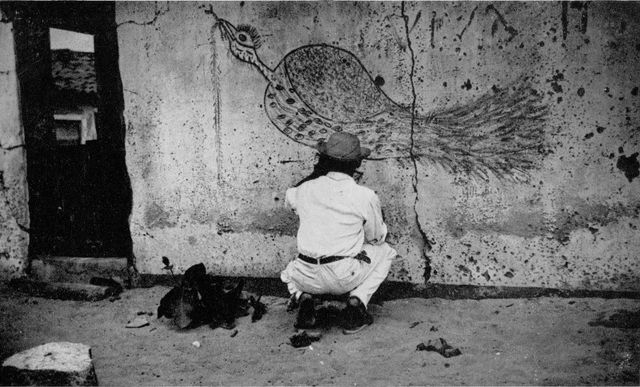
When Jean-Pierre Chabloz reached Fortaleza in 1943, the city had about 180,000 inhabitants, by the 1940 census, and an art world that had been organizing itself for two years. The painter and critic Estrigas called the decade the Fase Renovadora, the renewal phase, in a book of that title he published in 1983. Chico da Silva stood outside it. He drew in charcoal and brick on the fishermen’s walls at Praia Formosa, as told in the murals of Praia Formosa, and did not know the painters who met in the city centre. Even so, it was in this generation’s group shows that his work first appeared, though he had been through none of its schools.
The salons of 1941 to 1944
In the late 1930s, Estrigas writes in A saga do pintor Francisco Domingos da Silva (1988), Fortaleza had good painters, some with a name abroad, such as Raimundo Cela and Vicente Leite, and a younger generation starting to show. What it lacked was an organized movement, and the man who set one going, in his account, was Mário Baratta. In 1941 the Centro Cultural de Belas Artes (CCBA) was founded, the first visual arts body in Ceará. The group drew from the live model, went out in the morning and at night to paint the city (one destination was Poço da Draga, another name for Praia Formosa) and exhibited. The first Salão Cearense de Pintura opened in September 1941 at the Palácio do Comércio; the second followed in 1942 and the third in 1944, the first with prizes: Antônio Bandeira won painting, Baratta came second and João Maria Siqueira took the drawing prize.
In April 1943, between the second and the third salon, the state students’ union staged the first Salão de Abril, the April Salon. It had nine exhibitors, among them Raimundo Cela, the academic name in the show, Bandeira, Baratta, Aldemir Martins, Siqueira and a newcomer: Chabloz, a draughtsman for the service that recruited rubber workers for the Amazon. The press compared Bandeira’s watercolours Miséria e oração and Casebres entre árvores to Van Gogh, the sociologist Gerciane Oliveira records (2023).
On 27 August 1944 the CCBA gave way to the Sociedade Cearense de Artes Plásticas (SCAP, the Ceará Society of Visual Arts), with statutes, a studio, a library and courses. Among the first members Oliveira lists veterans of the Centro and new names: Barrica (Clidenor Capibaribe), Bandeira, Aldemir, Sérvulo Esmeraldo, Inimá de Paula from Minas Gerais, Zenon Barreto, Barboza Leite, Baratta and Chabloz himself. From 1946 the SCAP took over the Salão de Abril, which it ran until 1958.
Chabloz joins the circle
Chabloz fitted in fast. Estrigas tells how Barrica found him painting in a suburb and took him home for coffee, and how Baratta ran into him painting in the middle of the street. The political scientist David Silberstein, who studied the case in 1977, noted that Chabloz’s own painting stayed true to his academic training, though he encouraged those who painted otherwise. In one version of events it was through this circle that he heard about the walls at Praia Formosa; the meeting with Chico and what came of it are in Jean-Pierre Chabloz and the discovery of Chico da Silva.
Outside the circle, inside the salon
Chico never took part in the SCAP. Estrigas writes that he “got along only with Chabloz” and kept apart from the other artists. Roberto Galvão, in Chico da Silva e a Escola do Pirambu, adds that Bandeira, Aldemir and Siqueira liked the gouaches very much, but the public paid them no attention and the only buyer remained Chabloz. The writer Artur Eduardo Benevides, of the Clã literary group, told Galvão what it was like at Chabloz’s house: “Chabloz praised him as a very good primitivist.” The visitors heard the praise and went on paying the painter no mind.
Galvão dates Chico’s first exhibition to 1944, at the III Salão Cearense de Pintura, the same salon in which Bandeira won the painting prize. Chabloz entered the gouaches. The press that covered the salon barely mentioned them, and the painter Barboza Leite noted them years later in his book Esquema da pintura no Ceará (1949).
Looking back in 1988, Estrigas thought the distance had protected the painter. The artists never went after the “índio” to bring him into the group, and that, he wrote, may have been providential, since he could have lost his “original purity”. For Oliveira the distance was also Chabloz’s choice: he did not want to place a painter he saw as spontaneous inside a society built for training.
Rio, 1945: five from Ceará at the Askanasy
In 1945 Chabloz went to Rio with Bandeira and Inimá de Paula for a show at the Galeria Askanasy. The catalogue listed five names: those three, Raimundo Feitosa and Francisco Silva. Two of them came from no school at all. Feitosa, according to Baratta, had no “artistic culture” and painted with industrial enamel; the other was Chico. In his presentation the critic Rubem Navarra treated Chico as “a sort of guest of honour of the exhibition”, in Oliveira’s transcription, and wrote that in Brazilian art only Cícero Dias, ten years earlier, had given him so strong an impression of lyrical naivety. The rest of the critical response is in Primitive, naïf, Indigenous.
Baratta’s article in O Estado of 1 July 1945 is also worth reading for what it says about the generation. He defends the group’s programme, which for more than five years had sought “liberation from the academy” through the observation of nature, and foresees a school of Northeastern painting, just as there was already a Northeastern literature in José Lins do Rego, Rachel de Queiroz and Graciliano Ramos. He then accepts a warning from Navarra: the provinces let their talents wither, or let them flee. And he adds that the artist cannot live “in the province either, starving, for want of a public to buy his works”.
Those who left
That is what happened next. Bandeira and Aldemir left Ceará that same year to live in the south of Brazil and abroad. Silberstein writes that Ceará modernism soon lost its force and that the SCAP, though it lasted until 1958, lost its critical edge. He sees two poles in the generation: Bandeira and Aldemir, who found the means to take “the emigrant’s path”, and Chico, who without that option took “an inward path”.
For Chico that path began with a long pause. Chabloz sat on the jury of the 1948 Salão de Abril and went back to Europe the same year; without him, Chico went more than ten years without painting, according to Galvão, and none of his work entered the SCAP salons. When Chabloz returned in 1959, Estrigas describes the city he found: “The SCAP no longer existed, the artists were scattered.” The university’s art museum, the MAUC, took the society’s place, and it was there that Chico began painting again.
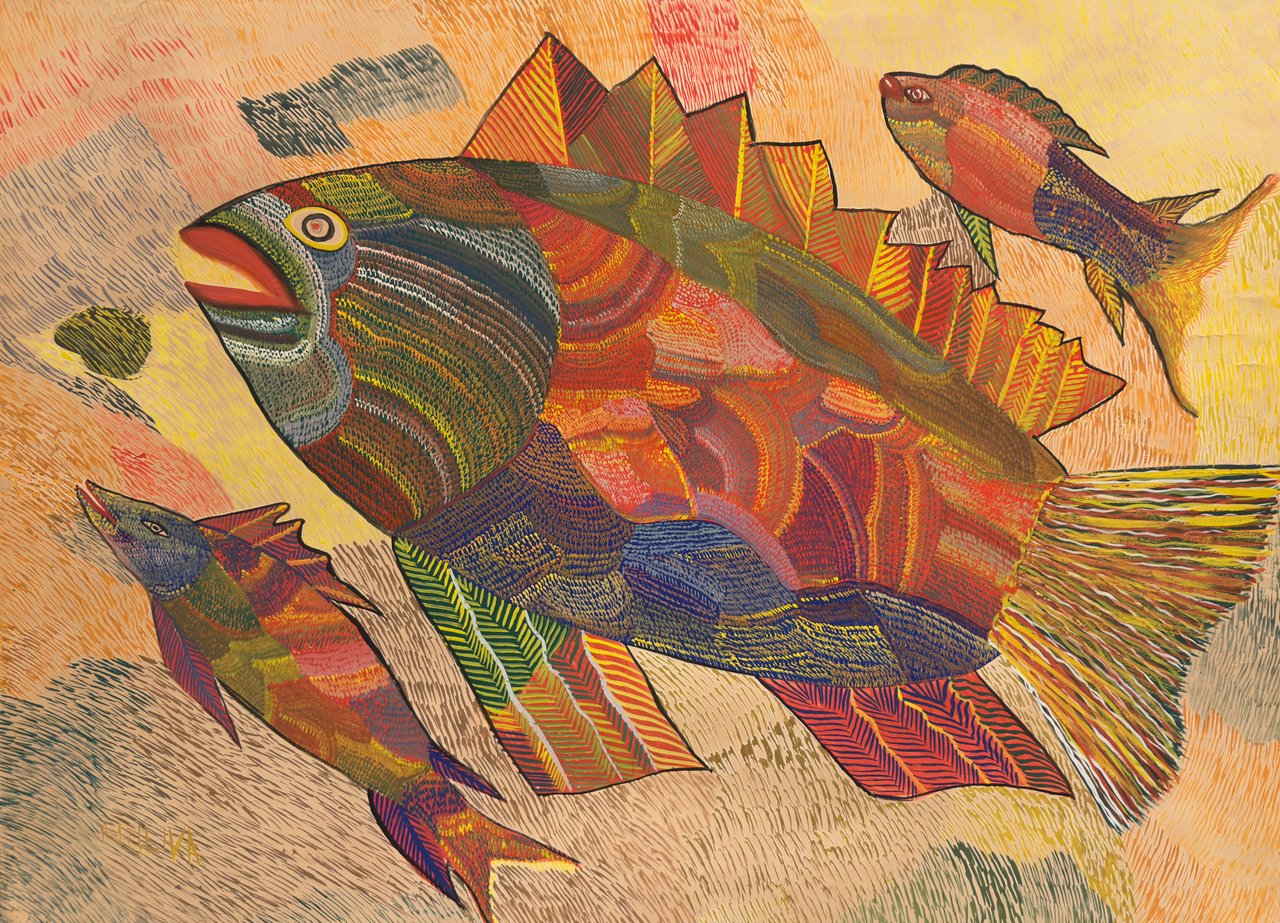
Peixes (Fish), a gouache on paper of about 1966 in the João Cunha Collection, belongs to the decade of that return: a large fish with an open mouth crosses the sheet, its body built of curved bands of short dashes and its back bristling with spines, between two smaller fish.
A Chico, a Bandeira, an Aldemir
In the 1960s the generation’s names crossed again, this time in the market. After his spell at the museum, Oliveira writes, a painting by Chico became as sought after by Fortaleza’s elite as a canvas by Bandeira or Aldemir. Aldemir wrote a text about him that Galvão and the 2001 catalogue reprint, the memory of a turkey drawn on a wall (“Red brick, white brick and charcoal made the turkey”), and ended it: “I believe and affirm that he is a major painter.” The cockfight, a motif the public associates with Chico, came into the Pirambu studio on commission: buyers asked for roosters like Aldemir’s, and Ivan de Assis adapted them from the cover of a school exercise book (Galvão, 2005).
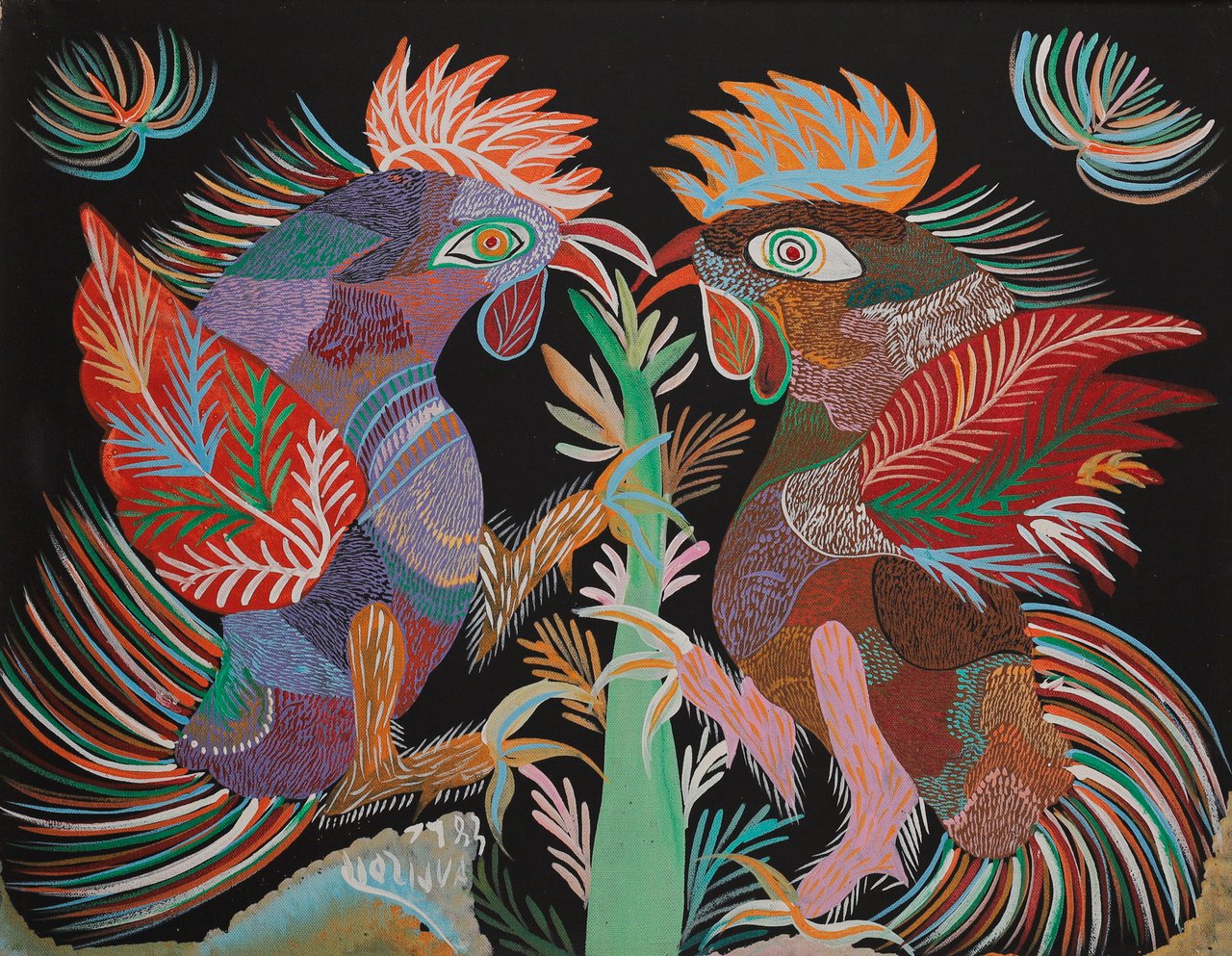
Galos de Briga (Fighting Cocks, 1983), acrylic on canvas in the collection, sets two spiky-crested roosters face to face on a black ground, their bodies covered in fine hatching in purple, red and white.
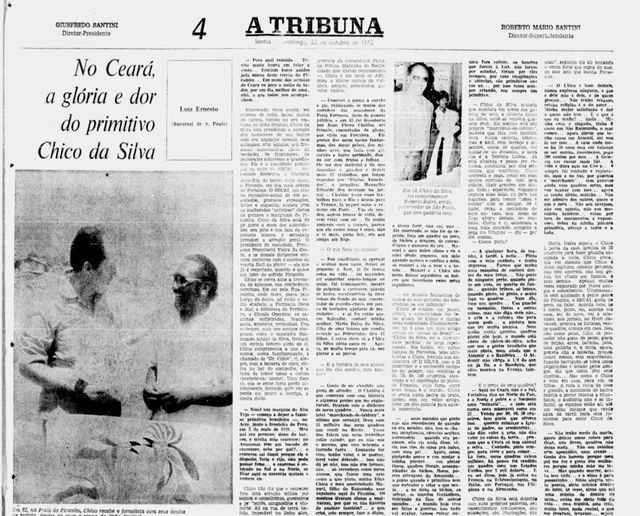
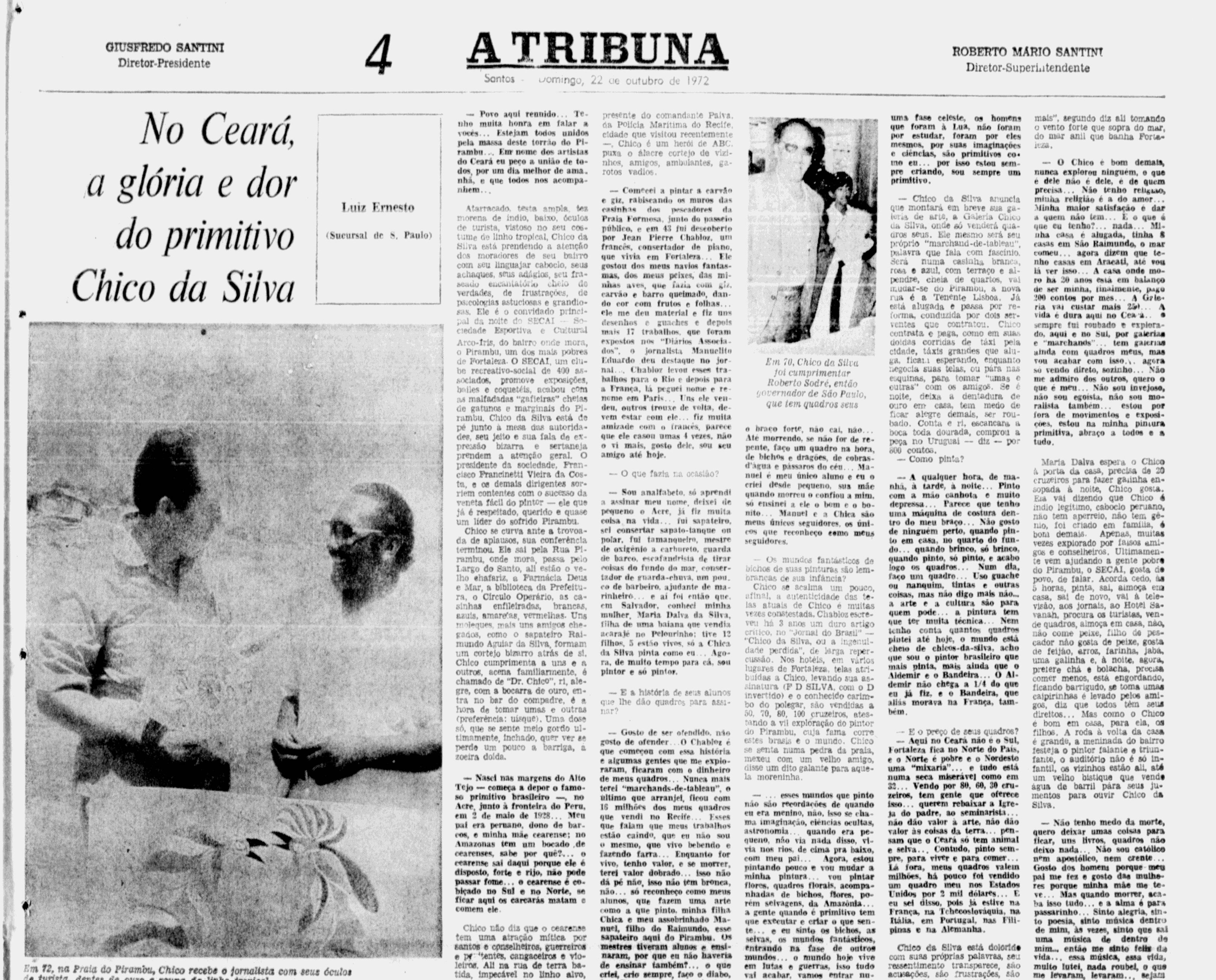
In 1972 Chico measured himself against the two in an interview with the journalist Luiz Ernesto Kawall: “I think I’m the Brazilian painter who paints the most, even more than Aldemir and Bandeira.” On the same page of A Tribuna, of Santos, the painter Hélio Rola described a Ceará of five galleries and a small market, and said that “the good artists here emigrate”, naming Aldemir and Bandeira. Eleven years later the 1983 auctions showed the gap between the three: by Oliveira’s count (2019), an oil by Bandeira fetched 1.1 million cruzeiros, one by Aldemir 1.6 million, and a painting by Chico in the same medium 20,000.
High-resolution viewer. Use the arrow keys to pan, plus and minus to zoom.
The Salão de Abril, later
The Salão de Abril outlived the SCAP and is still held today. In the list of group shows Estrigas published in 1988, Chico’s name appears at the XX Salão in 1970, with works lent by collectors; at the XXVII in 1977, when the master and his disciples painted the panel Homens Trabalhando in front of the public (see the Pirambu School); and in a special room in 1978. In 1986 the catalogue of the XXXVI Salão de Abril paid tribute to Chico and Chabloz.
Chico died on 6 December 1985. His body lay in state at the Casa de Cultura Raimundo Cela, and the press asked the city’s painters for comment. Sérvulo Esmeraldo, who had been part of the SCAP’s first activities, said the work did not fit the word naive: “Primitivist, yes, he had a great power of fabulation.” His works can be seen among the paintings of the collection, and the whole life is in the biography.